NEED TAX ADVICE QUICKLY OR YOUR TAX QUESTIONS ANSWERED – TRY OUR TAX ADVICE NOW SERVICE.  FIND OUT MORE…

Expanding Stateside: A Guide to Navigating US Employment Law for Australian Businesses

John Marcarian   |   17 Mar 2026   |   4 min read

Taking your Australian business to the United States is an exciting milestone, but it comes with a steep learning curve—especially regarding human resources and employment law. 

In Australia, businesses rely on a familiar, centralised system governed by the Fair Work Act 2009. However, the US operates under a highly decentralised, federalist system. For Aussie expats and expanding enterprises, this means adapting to overlapping federal, state, and local regulations that can vary wildly depending on your exact location. Here is your essential guide to understanding the US labour landscape.

Navigating A Fragmented Legal Landscape

In the US, federal employment laws establish the baseline protections for workers nationwide. Statutes like the Fair Labor Standards Act (FLSA) set minimum wage and overtime rules, while the Civil Rights Act and Americans with Disabilities Act (ADA) strictly prohibit workplace discrimination.

However, federal laws are merely the floor. Individual states—and even local cities—can enact significantly stricter protections. For instance, while the federal minimum wage is set at US$7.25 per hour, states like California and New York enforce much higher minimum wages, along with enhanced paid sick leave and wrongful termination protections. Cities like San Francisco and Seattle have even more restrictive local rules. An Australian company operating in both Texas and California will face starkly different compliance landscapes, making a state-by-state HR compliance strategy absolutely essential.

The “At-Will” Culture Shock

One of the biggest paradigm shifts for Australian employers is the US at-will employment doctrine. Unlike Australia, which mandates minimum notice periods and redundancy entitlements, most US jurisdictions allow employers to terminate a worker at any time, for any reason (or no reason at all), provided the reason is not illegal.

While this flexibility allows businesses to scale their workforces rapidly, it is not an absolute rule. Crucial exceptions exist that can easily lead to wrongful termination lawsuits:

  • Contractual Protections – Executives or unionised workers often negotiate “just-cause” termination clauses or severance agreements.
  • Public Policy – You cannot fire someone for whistleblowing, refusing to commit fraud, or exercising a legal right like filing a workers’ compensation claim.
  • Implied Contracts – Promises made in employee handbooks or during interviews can inadvertently create implied contracts, requiring employers to follow progressive disciplinary steps before firing. To protect your business, always include clear at-will disclaimers in offer letters and handbooks, and meticulously document your reasons for any termination.

The Benefits Gap: Healthcare and Retirement

Securing top talent in the US requires understanding that employee expectations differ vastly from those in Australia.

Healthcare Is An Employer Obligation

The US lacks a universal public system like Medicare. Because access to healthcare is heavily tied to employment, offering competitive, employer-sponsored health insurance is a fundamental necessity if you want to attract and retain quality staff.

The 401(k) vs. Superannuation

Instead of compulsory 11% superannuation contributions, the US utilises a voluntary defined-contribution system known as a 401(k). Employees contribute pre-tax income, and while it isn’t legally mandated, competitive employers usually match these contributions by 3% to 6%.

Navigating Payroll Taxes And Contractor Risks

US payroll taxes are a multi-tiered system. Rather than dealing with a single entity like the ATO, employers must withhold and match Federal Insurance Contributions Act (FICA) taxes, which fund Social Security (6.2%) and Medicare (1.45%). Additionally, employers are liable for both federal and state unemployment taxes (FUTA and SUTA), with state rates fluctuating based on your specific industry and history of layoffs.

Finally, if you plan to hire freelancers, tread carefully. The IRS and Department of Labor strictly enforce worker classification laws. Misclassifying an employee as an independent contractor can trigger severe fines, back-pay claims, and lawsuits. Ensure you have well-drafted independent contractor agreements that clearly define the project scope, payment terms, and the worker’s independent status.

Conclusion

Expanding into the American market is not a one-size-fits-all endeavour. By implementing centralised HR compliance systems, understanding local legislative nuances, and consulting with US labour attorneys, Australian businesses can successfully mitigate risks and build a thriving stateside workforce.

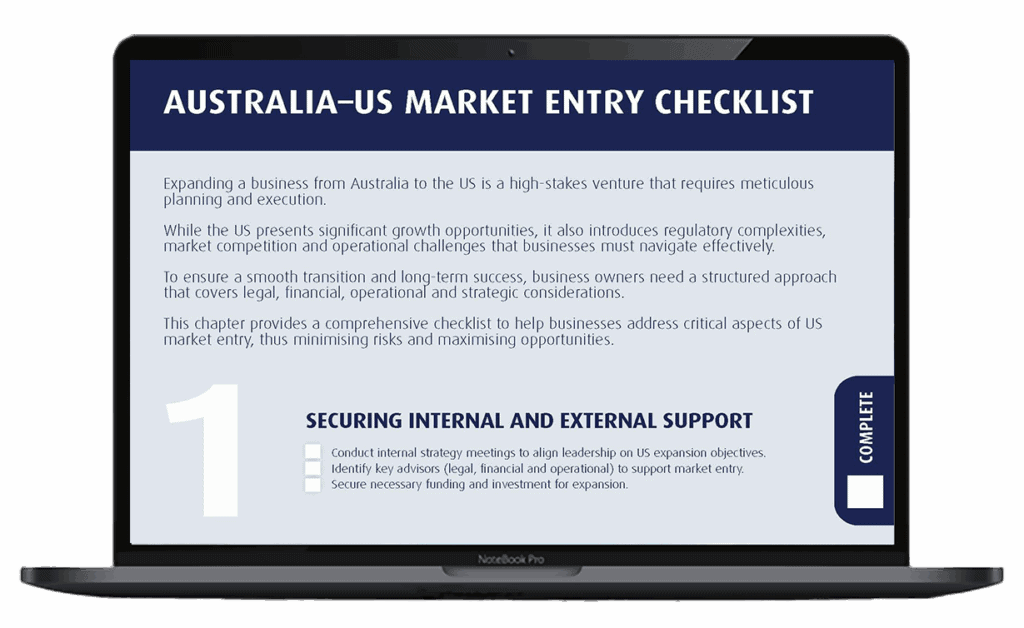
CHECKLIST: Australia – US Market Entry Checklist

To assist you and your team we have created the “Australia-US Market Entry Checklist“. The checklist guides your team through:

  • Identifying the most appropriate and strategic pathways for US expansion by Australian businesses.
  • Reducing expansion risk through clear tax, legal, and regulatory guidance.
  • Enabling a smooth transition into the US market and maximising long-term success.

NEED ASSISTANCE FOR YOUR SITUATION?

Contact us today
Contact Us

"*" indicates required fields

Do you need tax services in our other regions?
By providing us your information you agree to our privacy policy

Determining Corporate Residency

Use our online tool to determine the corporate residency of your client's business.

Corporate Residency

Please provide your details to access the online tool

Name is required.

Email is required.

Determining Corporate Residency

Use our online tool to determine the corporate residency of your client's business.

Place of
Incorporation

Is the company incorporated outside Australia?

Determining Corporate Residency

Use our online tool to determine the corporate residency of your client's business.

Central Management
and Control

Is the Central Management and Control
of the company exercised in Australia?

Determining Corporate Residency

Use our online tool to determine the corporate residency of your client's business.

Carry on a Business

Does the company carry on a business in Australia?

Determining Corporate Residency

Use our online tool to determine the corporate residency of your client's business.

Voting Power

Is the company's voting power controlled
by shareholders who are residents of Australia?

Determining Corporate Residency

Use our online tool to determine the corporate residency of your client's business.

The company is an Australian Resident

Contact us for tailored international tax advice
regarding your client's specific situation.

Contact us for tailored international tax advice regarding your client's specific situation.

Contact Us

Determining Corporate Residency

Use our online tool to determine the corporate residency of your client's business.

The company is not a resident
but it could be a CFC

Contact us for tailored international tax advice
regarding your client's specific situation.

Contact us for tailored international tax advice regarding your client's specific situation.

Contact Us

Determining Corporate Residency

Use our online tool to determine the corporate residency of your client's business.

Contact Us

"*" indicates required fields

By providing us your information you agree to our privacy policy

More articles like this


Does Your Wise Account Need To Be Reported On FBAR Or FATCA?


6th Mar 2026
Marcus Shimotsu

If you live internationally, run an online business, invest across borders, or use platforms like Wise to manage multiple currencies, you may be wondering: Do I need to report my Wise account to...


Immigration And Visas: The Practical Playbook For Australian Businesses Entering The US


20th Feb 2026
John Marcarian

Expanding into the US can be a growth-defining move for an Australian business — new customers, deeper capital markets, a bigger talent pool But there’s one reality that catches founders off...


Australian Businesses Expanding to the USA – Structuring Your Business for US Expansion


27th Jan 2026
John Marcarian

Most Australian businesses don’t fail in the United States because the market rejects them  They fail because the structure underneath them wasn’t built for the way the US actually...


Does Your Wise Account Need To Be Reported On FBAR Or FATCA?


6th Mar 2026
Marcus Shimotsu

If you live internationally, run an online business, invest across borders, or use platforms like Wise to manage multiple currencies, you may be...


Immigration And Visas: The Practical Playbook For Australian Businesses Entering The US


20th Feb 2026
John Marcarian

Expanding into the US can be a growth-defining move for an Australian business — new customers, deeper capital markets, a bigger talent pool But...


Australian Businesses Expanding to the USA – Structuring Your Business for US Expansion


27th Jan 2026
John Marcarian

Most Australian businesses don’t fail in the United States because the market rejects them  They fail because the structure underneath...

Does Your Wise Account Need To Be Reported On FBAR Or FATCA?

Marcus Shimotsu   |   6 Mar 2026   |   4 min read

If you live internationally, run an online business, invest across borders, or use platforms like Wise to manage multiple currencies, you may be wondering:

Do I need to report my Wise account to the IRS?

The answer depends on one key factor:
Where the account is legally held, and not the currency and not the routing number.

Let’s break this down clearly.

The Two Reporting Regimes: FBAR And FATCA

U.S. taxpayers may need to report foreign accounts under:

1. FBAR (FinCEN Form 114)

You must file an FBAR if:

  • You are a U.S. person (citizen, green card holder, or U.S. tax resident), and
  • The total value of all your foreign financial accounts exceeds $10,000 at any time during the year.

2. FATCA (Form 8938)

This form is filed with your tax return and applies if your foreign financial assets exceed higher thresholds (which vary based on where you live and your filing status).

Both rules focus on whether an account is foreign.

What Actually Makes An Account “Foreign”?

This is where confusion happens.

An account is considered foreign if it is maintained by a financial institution located outside the United States.

That’s it.

Not:

  • The currency
  • The interface language
  • The debit card logo
  • The routing number format

What matters is which legal entity holds your account and where that entity is regulated.

Common Misconceptions About Wise Accounts

Wise operates through multiple regulated entities around the world, including in the U.S., UK, Belgium, and elsewhere.

Depending on your residency and how you opened the account, your Wise account may be held by:

  • A U.S. entity (domestic), or
  • A non-U.S. entity (foreign)

Important Clarifications

  • Just because your Wise account holds USD does NOT mean it is domestic.
  • Just because your account holds EUR does NOT mean it is foreign.
  • Just because your account uses U.S. payment rails (like an ABA routing number) does NOT mean it is domestic.

Payment rails are not the legal location of the financial institution.

An account can:

  • Hold U.S. dollars,
  • Have an ABA routing number,
  • Send ACH payments,

and still be legally maintained by a foreign financial institution.

Simple Examples

Example 1: USD Account That Is Foreign

You live abroad and open a Wise account. It holds only U.S. dollars. It has an ABA routing number.

However, your account is maintained by Wise’s UK or EU entity.

That account is considered foreign for FBAR and FATCA purposes.

If your total foreign accounts exceed $10,000 at any point during the year, it must be reported.

Example 2: EUR Account That Is Not Foreign

You live in the United States and open a Wise account issued by Wise’s U.S. entity. You hold euros in it.

Even though the balance is in EUR, the account is maintained in the United States.

That account is generally not foreign for FBAR purposes.

Currency does not determine reporting — location does.

Why This Matters

Many internationally mobile professionals and online entrepreneurs:

  • Hold multiple currency balances
  • Move funds across borders frequently
  • Use fintech platforms instead of traditional banks
  • Assume “digital” means “not foreign”

That assumption can create compliance risk.

FBAR penalties can be severe — even for non-willful violations.

How to Determine If Your Wise Account Is Foreign

Here’s what you should check:

  1. Review your account terms and conditions.
  2. Look at your statements — they usually identify the regulated entity.
  3. Confirm which Wise legal entity services your account.
  4. Identify where that entity is regulated.

If the account is maintained by a non-U.S. entity, it is generally considered a foreign financial account.

Aggregation Rule (Often Overlooked)

For FBAR purposes:

You must combine the maximum balances of all your foreign accounts.

If the total exceeds $10,000 at any point during the year, you must report all of them — even if each individual account is small.

Wise accounts count toward that total if they are foreign.

Bottom Line

When it comes to FBAR and FATCA:

  • USD does not mean domestic.
  • EUR does not mean foreign.
  • An ABA routing number does not make an account U.S.-based.
  • Digital platforms are not automatically exempt.
  • The legal location of the institution controls.

If you operate internationally and use modern fintech tools, it’s critical to analyze your accounts properly rather than relying on assumptions based on currency or payment systems.

When in doubt, verify the entity and not the interface.

NEED ASSISTANCE FOR YOUR SITUATION?

Contact us today
Contact Us

"*" indicates required fields

Do you need tax services in our other regions?
By providing us your information you agree to our privacy policy

Determining Corporate Residency

Use our online tool to determine the corporate residency of your client's business.

Corporate Residency

Please provide your details to access the online tool

Name is required.

Email is required.

Determining Corporate Residency

Use our online tool to determine the corporate residency of your client's business.

Place of
Incorporation

Is the company incorporated outside Australia?

Determining Corporate Residency

Use our online tool to determine the corporate residency of your client's business.

Central Management
and Control

Is the Central Management and Control
of the company exercised in Australia?

Determining Corporate Residency

Use our online tool to determine the corporate residency of your client's business.

Carry on a Business

Does the company carry on a business in Australia?

Determining Corporate Residency

Use our online tool to determine the corporate residency of your client's business.

Voting Power

Is the company's voting power controlled
by shareholders who are residents of Australia?

Determining Corporate Residency

Use our online tool to determine the corporate residency of your client's business.

The company is an Australian Resident

Contact us for tailored international tax advice
regarding your client's specific situation.

Contact us for tailored international tax advice regarding your client's specific situation.

Contact Us

Determining Corporate Residency

Use our online tool to determine the corporate residency of your client's business.

The company is not a resident
but it could be a CFC

Contact us for tailored international tax advice
regarding your client's specific situation.

Contact us for tailored international tax advice regarding your client's specific situation.

Contact Us

Determining Corporate Residency

Use our online tool to determine the corporate residency of your client's business.

Contact Us

"*" indicates required fields

By providing us your information you agree to our privacy policy

More articles like this


Expanding Stateside: A Guide to Navigating US Employment Law for Australian Businesses


17th Mar 2026
John Marcarian

Taking your Australian business to the United States is an exciting milestone, but it comes with a steep learning curve—especially regarding human resources and employment law  In...


Immigration And Visas: The Practical Playbook For Australian Businesses Entering The US


20th Feb 2026
John Marcarian

Expanding into the US can be a growth-defining move for an Australian business — new customers, deeper capital markets, a bigger talent pool But there’s one reality that catches founders off...


Australian Businesses Expanding to the USA – Structuring Your Business for US Expansion


27th Jan 2026
John Marcarian

Most Australian businesses don’t fail in the United States because the market rejects them  They fail because the structure underneath them wasn’t built for the way the US actually...


Expanding Stateside: A Guide to Navigating US Employment Law for Australian Businesses


17th Mar 2026
John Marcarian

Taking your Australian business to the United States is an exciting milestone, but it comes with a steep learning curve—especially regarding human...


Immigration And Visas: The Practical Playbook For Australian Businesses Entering The US


20th Feb 2026
John Marcarian

Expanding into the US can be a growth-defining move for an Australian business — new customers, deeper capital markets, a bigger talent pool But...


Australian Businesses Expanding to the USA – Structuring Your Business for US Expansion


27th Jan 2026
John Marcarian

Most Australian businesses don’t fail in the United States because the market rejects them  They fail because the structure underneath...

Immigration And Visas: The Practical Playbook For Australian Businesses Entering The US

John Marcarian   |   20 Feb 2026   |   8 min read

Expanding into the US can be a growth-defining move for an Australian business — new customers, deeper capital markets, a bigger talent pool. But there’s one reality that catches founders off guard: in the US, immigration isn’t a “formality.” It’s a regulated operating system. If you treat it like admin, it will eventually treat you like a compliance event.

At a high level, three agencies shape most employment- and investment-based pathways:

  • USCIS (US Citizenship and Immigration Services) – adjudicates petitions and many work-authorisation processes inside the US
  • DOL (Department of Labor) – protects US wage and working-condition standards (especially for employer-sponsored roles)
  • DOS (Department of State) – issues visas at US embassies/consulates outside the US

When these agencies don’t align — or when documentation isn’t airtight — the cost is rarely “just delay.” It can disrupt onboarding, derail projects, and create legal exposure you don’t want attached to your US launch.

The E-3 Visa: Australia’s Unfair Advantage (When You Can Use It)

For many Australian companies and professionals, the E-3 is the cleanest entry point. It’s available only to Australian citizens working in a specialty occupation (typically requiring at least a bachelor’s degree or equivalent).

Why it’s so attractive:

  • A dedicated annual cap (10,500) that has historically not been reached
  • Lower friction and cost compared to many alternatives
  • Renewable in two-year increments with the ability to extend repeatedly (so long as eligibility remains)

A major practical benefit: spouses of E-3 holders can obtain work authorisation (EAD) and work broadly in the US. For many families, that single feature makes the E-3 dramatically more livable than other work visas.

The key constraint: E-3 is not “dual intent.” In plain English: it’s designed as a temporary visa. You generally need to maintain the narrative (and supporting facts) that you intend to return to Australia. That doesn’t make a future green card impossible, but it does mean you need a plan — and you need to time it properly.

When E-3 Doesn’t Fit: The Other Work Visa Lanes

If the role or candidate doesn’t qualify for E-3 — or if permanent residency is part of the strategy — the next options depend on your structure and the person’s profile.

H-1B: The Well-Known Option (And The Lottery Problem)

H-1B also targets specialty occupations, but it’s open to all nationalities — which is why it’s heavily oversubscribed. Most applicants face a lottery due to annual caps (commonly referenced as 65,000 plus an additional 20,000 for certain US master’s degree holders).

Why companies still use it:

  • Dual Intent (clearer alignment with future green card planning)

The downside many families feel most:

  • Spousal work rights can be more limited and situational than E-3 (some H-4 spouses can qualify for an EAD under specific conditions, but it’s not as straightforward as E-3/E-2 in practice).

L-1: Ideal For Intracompany Transfers (If You Have The Structure)

L-1 is often the most logical pathway when you have a real operating company in Australia and you’re transferring someone to a US entity.

  • L-1A for executives/managers
  • L-1B for specialised knowledge staff
  • Requires the employee to have worked for the overseas entity for at least one year within the preceding three years (in most cases)
  • Dual intent is permitted

This visa often works best when your corporate structure and role definitions are clean — and when your organisational chart supports what you’re claiming.

O-1: For Top-Tier Profiles With Evidence To Match

The O-1 is for individuals with extraordinary ability (business, science, arts, etc.). There’s no annual cap, and extensions can continue as long as the work remains eligible.

But this is not a “strong resume” visa — it’s an evidence visa. Think:

  • major awards or significant recognition
  • published material about the person
  • critical roles in distinguished organisations
  • judging, original contributions, high salary, and other recognised criteria

If the story is “they’re excellent,” O-1 is hard. If the story is “their excellence is documented by third parties,” O-1 becomes very viable.

The E-2 Visa: The Founder/Operator Pathway

For entrepreneurs and owner-operators, E-2 can be a powerful route. Australia is a treaty country for E-2, and the visa is designed for people who will develop and direct a US business they’ve invested in.

Key points that matter in real life:

  • You generally need to own at least 50% (or otherwise control the enterprise)
  • The investment must be substantial and genuinely at risk (committed and exposed to loss)
  • There’s no fixed minimum, but in practice investments often sit in a broad range (commonly US$100k–$500k+, depending on the business model)
  • The business can’t be “marginal” — it should be capable of supporting more than just the investor’s household over time

Like the E-3, a major family advantage is that E-2 spouses can obtain open work authorisation.

Compliance That Actually Matters: LCAs, Files, And Timelines

For E-3 and H-1B, one recurring compliance anchor is the Labor Condition Application (LCA). This is where the employer certifies (to the DOL) that the worker will be paid appropriately (prevailing wage rules) and that hiring them won’t undercut local working conditions.

A few operational truths:

  • Processing timelines vary – E-3 can often be relatively quick; H-1B and some USCIS petitions can take longer due to caps, scrutiny, and workflow
  • Your file is your defence– job descriptions, wage rationale, organisational charts, degree equivalency support, and consistent HR records matter more than people expect
  • Tracking expiry dates isn’t optional – late renewals create avoidable risk and business interruption

The Tax Trap: Immigration Status ≠ Tax Status

This is the part that blindsides many Australians.

Your visa category does not determine US tax residency. The IRS applies the Substantial Presence Test, which is based on days in the US over a rolling period. It’s entirely possible to be on a temporary visa and still become a US tax resident, meaning worldwide income may enter the US tax net.

That can pull in items Australians don’t expect to be “in play,” including:

  • investment income from Australia
  • complex treatment questions around superannuation
  • reporting regimes that can apply to foreign accounts and entities
  • state tax exposure (often the nastiest surprise), especially in places like California and New York, which operate with their own rules and don’t “care” as much about treaty outcomes as people assume

The US–Australia tax treaty can help mitigate double taxation, but treaties don’t automatically make complexity disappear — they often just change how you need to document and position the outcome.

The Mistakes That Create Expensive Problems

A few patterns show up again and again in US market entries:

  • Misclassifying Employees As Contractors To “Simplify Payroll”
    This can trigger issues with the DOL and IRS, and it’s a fast way to attract scrutiny.
  • Building The US Plan First And Asking Immigration To “Make It Work” Later
    Better approach: design the role, entity structure, and timeline with the visa pathway in mind.
  • Overstays And Timing Errors
    Overstaying by more than 180 days can trigger a three-year re-entry bar, and one year can trigger a ten-year bar. Those are business-ending outcomes for the wrong person at the wrong time.

A Practical Way To Think About It

If you’re entering the US, treat immigration and tax as two parallel workstreams:

  1. Immigration Workstream – right visa, right evidence, right timing
  2. Tax Workstream – residency modelling, entity/payroll setup, cross-border reporting, state exposure

When those two streams are coordinated early, the US expansion feels controllable. When they’re not, businesses find themselves reacting — and reaction is always more expensive than design.

General information only — not legal or tax advice. US immigration and tax outcomes depend heavily on facts, timing, and documentation.

CHECKLIST: Australia – US Market Entry Checklist

To assist you and your team we have created the “Australia-US Market Entry Checklist“. The checklist guides your team through:

  • Identifying the most appropriate and strategic pathways for US expansion by Australian businesses.
  • Reducing expansion risk through clear tax, legal, and regulatory guidance.
  • Enabling a smooth transition into the US market and maximising long-term success.

NEED ASSISTANCE FOR YOUR SITUATION?

Contact us today
Contact Us

"*" indicates required fields

Do you need tax services in our other regions?
By providing us your information you agree to our privacy policy

Determining Corporate Residency

Use our online tool to determine the corporate residency of your client's business.

Corporate Residency

Please provide your details to access the online tool

Name is required.

Email is required.

Determining Corporate Residency

Use our online tool to determine the corporate residency of your client's business.

Place of
Incorporation

Is the company incorporated outside Australia?

Determining Corporate Residency

Use our online tool to determine the corporate residency of your client's business.

Central Management
and Control

Is the Central Management and Control
of the company exercised in Australia?

Determining Corporate Residency

Use our online tool to determine the corporate residency of your client's business.

Carry on a Business

Does the company carry on a business in Australia?

Determining Corporate Residency

Use our online tool to determine the corporate residency of your client's business.

Voting Power

Is the company's voting power controlled
by shareholders who are residents of Australia?

Determining Corporate Residency

Use our online tool to determine the corporate residency of your client's business.

The company is an Australian Resident

Contact us for tailored international tax advice
regarding your client's specific situation.

Contact us for tailored international tax advice regarding your client's specific situation.

Contact Us

Determining Corporate Residency

Use our online tool to determine the corporate residency of your client's business.

The company is not a resident
but it could be a CFC

Contact us for tailored international tax advice
regarding your client's specific situation.

Contact us for tailored international tax advice regarding your client's specific situation.

Contact Us

Determining Corporate Residency

Use our online tool to determine the corporate residency of your client's business.

Contact Us

"*" indicates required fields

By providing us your information you agree to our privacy policy

More articles like this


Expanding Stateside: A Guide to Navigating US Employment Law for Australian Businesses


17th Mar 2026
John Marcarian

Taking your Australian business to the United States is an exciting milestone, but it comes with a steep learning curve—especially regarding human resources and employment law  In...


Does Your Wise Account Need To Be Reported On FBAR Or FATCA?


6th Mar 2026
Marcus Shimotsu

If you live internationally, run an online business, invest across borders, or use platforms like Wise to manage multiple currencies, you may be wondering: Do I need to report my Wise account to...


Australian Businesses Expanding to the USA – Structuring Your Business for US Expansion


27th Jan 2026
John Marcarian

Most Australian businesses don’t fail in the United States because the market rejects them  They fail because the structure underneath them wasn’t built for the way the US actually...


Expanding Stateside: A Guide to Navigating US Employment Law for Australian Businesses


17th Mar 2026
John Marcarian

Taking your Australian business to the United States is an exciting milestone, but it comes with a steep learning curve—especially regarding human...


Does Your Wise Account Need To Be Reported On FBAR Or FATCA?


6th Mar 2026
Marcus Shimotsu

If you live internationally, run an online business, invest across borders, or use platforms like Wise to manage multiple currencies, you may be...


Australian Businesses Expanding to the USA – Structuring Your Business for US Expansion


27th Jan 2026
John Marcarian

Most Australian businesses don’t fail in the United States because the market rejects them  They fail because the structure underneath...

Australian Businesses Expanding to the USA – Structuring Your Business for US Expansion

John Marcarian   |   27 Jan 2026   |   6 min read

Most Australian businesses don’t fail in the United States because the market rejects them. 

They fail because the structure underneath them wasn’t built for the way the US actually works.

From a distance, the US looks like one market. 

In practice, it’s a federal system sitting on top of fifty separate state regimes, each with its own tax rules, registration requirements, employment laws and compliance triggers. What works neatly in Australia can become awkward very quickly once you have people on the ground, customers in multiple states, or inventory crossing state lines.

That’s why the first mistake is usually asking the wrong question.

The question isn’t “Should we set up in Delaware?”
The real question is “What are we actually building in the US?”

If the plan is to test the water,  a small team, early customers, limited capital at risk and a structure that needs to stay flexible. If the plan is to scale, raise capital, issue equity to US hires and keep exit options open, the structure needs to look like something the US market already understands.

Most Australian businesses end up in one of those two lanes, whether they realise it or not.

Where the ambition is serious growth, the default answer is often a US C-Corporation. 

Not because it’s clever, but because it’s familiar. US investors, banks, lawyers and employees all know how to deal with it. Equity can be issued cleanly. Option plans work the way people expect. Governance is recognisable. Due diligence is faster because the shape of the company makes sense to the people looking at it.

The trade-off is that C-Corps come with formality and tax layering. There is corporate tax at the company level and tax again when profits are distributed. Board processes matter. Records matter. But that discipline is usually the price of admission if you want to play properly in the US growth market.

At the other end of the spectrum sits the LLC, which often gets sold as the “simple” option. And in the right circumstances, it can be. LLCs offer limited liability, fewer rigid corporate rules and a lot of flexibility in how economics and control are documented.

The catch though and it’s a big one for Australians is that simplicity in the US domestic context doesn’t always translate neatly across borders. The way an LLC is treated for US tax depends on elections and ownership, and foreign owners can find themselves pulled into US tax filings and reporting in ways they didn’t anticipate. Add state-level fees and compliance, and the “easy” structure can become anything but if it hasn’t been thought through properly.

That doesn’t make LLCs wrong. It just means they need to be chosen deliberately, not by default.

Then there are the structures that sound familiar but rarely fit. S-Corporations are popular with small US businesses, but they generally don’t work for Australian expansion because of tight ownership and equity restrictions. Partnerships can be excellent for joint ventures and specific commercial arrangements, but when foreign partners are involved, withholding and reporting obligations in the US can quickly outweigh the flexibility they offer.

What often gets missed entirely in early conversations is whether a US subsidiary is even the right first step. Some Australian businesses initially operate in the US as an Australian entity registered at the state level, particularly where activity is limited or transitional. In other cases, a clean US subsidiary is essential from day one to contain risk, satisfy customers or prepare for an eventual sale. There’s no universal rule but the choice has real consequences for liability, tax exposure and how easy it is to unwind or exit later.

Another blind spot is the assumption that incorporation solves everything. 

It doesn’t. In the US, obligations are driven less by where you’re incorporated and more by where you actually operate. 

Hire people in one state, warehouse goods in another, sell software into several more, and you can quickly find yourself dealing with multiple tax authorities and registration regimes. Sales tax in particular has a habit of appearing earlier than expected, especially for digital and e-commerce businesses.

And then there’s the question that almost always gets left until too late, how does the money come home?

Funding a US operation, charging for IP, repatriating profits and documenting intercompany arrangements are not clean-up exercises. 

They’re foundational. The longer they’re left, the more value gets trapped behind structures that weren’t designed to move it efficiently.

The same applies to people. The moment you hire in the US, everything becomes real, payroll, employment compliance, benefits, insurance, and expectations around equity. 

This is another reason growth-oriented businesses often gravitate to C-Corp structures early, US employees understand them, and equity incentives actually work the way they’re supposed to.

The pattern, after years of watching Australian businesses expand into the US, is fairly consistent. The companies that do well are not the ones with the cleverest structures. They are the ones that chose a structure that matched their ambition, accepted the discipline that came with it, and put the foundations in place before momentum made change difficult.

The ones that struggle usually weren’t reckless. They were just early optimists. They picked something that worked “for now” and assumed they’d fix it later. In the US, later tends to arrive during fundraising, diligence or a dispute when flexibility is at its lowest and the cost of change is at its highest.

General information only. Not advice. But if you’re planning a US expansion, it’s worth remembering this, the market is big, forgiving and full of opportunity but it has very little patience for structures that don’t match the story you’re trying to tell.

CHECKLIST: Australia – US Market Entry Checklist

To assist you and your team we have created the “Australia-US Market Entry Checklist“. The checklist guides your team through:

  • Identifying the most appropriate and strategic pathways for US expansion by Australian businesses.
  • Reducing expansion risk through clear tax, legal, and regulatory guidance.
  • Enabling a smooth transition into the US market and maximising long-term success.

NEED ASSISTANCE FOR YOUR SITUATION?

Contact us today
Contact Us

"*" indicates required fields

Do you need tax services in our other regions?
By providing us your information you agree to our privacy policy

Determining Corporate Residency

Use our online tool to determine the corporate residency of your client's business.

Corporate Residency

Please provide your details to access the online tool

Name is required.

Email is required.

Determining Corporate Residency

Use our online tool to determine the corporate residency of your client's business.

Place of
Incorporation

Is the company incorporated outside Australia?

Determining Corporate Residency

Use our online tool to determine the corporate residency of your client's business.

Central Management
and Control

Is the Central Management and Control
of the company exercised in Australia?

Determining Corporate Residency

Use our online tool to determine the corporate residency of your client's business.

Carry on a Business

Does the company carry on a business in Australia?

Determining Corporate Residency

Use our online tool to determine the corporate residency of your client's business.

Voting Power

Is the company's voting power controlled
by shareholders who are residents of Australia?

Determining Corporate Residency

Use our online tool to determine the corporate residency of your client's business.

The company is an Australian Resident

Contact us for tailored international tax advice
regarding your client's specific situation.

Contact us for tailored international tax advice regarding your client's specific situation.

Contact Us

Determining Corporate Residency

Use our online tool to determine the corporate residency of your client's business.

The company is not a resident
but it could be a CFC

Contact us for tailored international tax advice
regarding your client's specific situation.

Contact us for tailored international tax advice regarding your client's specific situation.

Contact Us

Determining Corporate Residency

Use our online tool to determine the corporate residency of your client's business.

Contact Us

"*" indicates required fields

By providing us your information you agree to our privacy policy

More articles like this


Expanding Stateside: A Guide to Navigating US Employment Law for Australian Businesses


17th Mar 2026
John Marcarian

Taking your Australian business to the United States is an exciting milestone, but it comes with a steep learning curve—especially regarding human resources and employment law  In...


Does Your Wise Account Need To Be Reported On FBAR Or FATCA?


6th Mar 2026
Marcus Shimotsu

If you live internationally, run an online business, invest across borders, or use platforms like Wise to manage multiple currencies, you may be wondering: Do I need to report my Wise account to...


Immigration And Visas: The Practical Playbook For Australian Businesses Entering The US


20th Feb 2026
John Marcarian

Expanding into the US can be a growth-defining move for an Australian business — new customers, deeper capital markets, a bigger talent pool But there’s one reality that catches founders off...


Expanding Stateside: A Guide to Navigating US Employment Law for Australian Businesses


17th Mar 2026
John Marcarian

Taking your Australian business to the United States is an exciting milestone, but it comes with a steep learning curve—especially regarding human...


Does Your Wise Account Need To Be Reported On FBAR Or FATCA?


6th Mar 2026
Marcus Shimotsu

If you live internationally, run an online business, invest across borders, or use platforms like Wise to manage multiple currencies, you may be...


Immigration And Visas: The Practical Playbook For Australian Businesses Entering The US


20th Feb 2026
John Marcarian

Expanding into the US can be a growth-defining move for an Australian business — new customers, deeper capital markets, a bigger talent pool But...

Significant Deductions In A U.S. Personal Tax Return

John Marcarian   |   9 Dec 2025   |   6 min read

A Practical Guide For Australians And Globally Mobile Founders

For Australians moving to the United States — as executives, investors, or globally mobile founders — the U.S. personal tax system can feel both familiar and foreign. The rules are extensive, the terminology takes getting used to, and the way deductions operate is fundamentally different from Australia’s.

Where Australia offers targeted deductions within a tightly defined framework, the U.S. system blends statute, history, case law, and political compromise. For internationally mobile taxpayers, that combination creates both unexpected pitfalls and valuable planning opportunities.

This article provides a clear guide to the most significant deductions available on a U.S. personal tax return, complete with examples that reflect the situations Australians commonly face.

1.  Above-The-Line Deductions — The Most Valuable Deductions You Can Claim Without Itemising

Above-the-line deductions reduce Adjusted Gross Income (AGI), which then determines eligibility for further deductions and credits. Reducing AGI is often the single most powerful tax optimisation strategy for globally mobile individuals.

Retirement Contributions: IRA, SEP IRA And Solo 401(k)

Contributions to traditional IRAs may be deductible depending on income and employer-plan participation. For self-employed founders operating in the U.S., SEP IRAs and Solo 401(k)s offer substantial deductible contributions.

Example:
Michael, an Australian executive earning USD 160,000 in the U.S., contributes to his employer’s 401(k). Because he is already covered by that plan, his IRA contribution is not deductible due to income limits.

However, if Michael were self-employed and earned the same amount, a SEP IRA could allow deductible contributions of tens of thousands of dollars.

Health Savings Accounts (HSAs)

Unique to the U.S., HSAs allow deductible contributions, tax-free earnings, and tax-free withdrawals for medical expenses. Australians often find HSAs to be one of the most generous structures in the U.S. system.

Example:
Sarah, an Australian relocating to California, switches to a qualifying high-deductible health plan and contributes USD 8,300 into an HSA for her family.

This contribution is fully deductible, grows tax-free, and withdrawals for medical expenses remain tax-free. No Australian equivalent exists.

Self-Employed Deductions

For entrepreneurs and consultants, these include:

  • Self-employed health insurance
  • Half of self-employment tax
  • Qualified retirement plan contributions
  • Certain business expenses

Example:
An Australian consultant billing USD 220,000 through a U.S. LLC deducts:

  • USD 9,000 in self-employed health insurance
  • USD 8,000+ for half of self-employment tax
  • USD 20,000–40,000 in retirement contributions

These deductions significantly reduce taxable income.

2. Standard Deduction vs. Itemised Deductions — The Annual Decision

Each taxpayer chooses either:

  • The Standard Deduction, or
  • Itemised Deductions, if they exceed the standard deduction.

Standard Deduction Example:

David and Emma, an Australian couple living in Texas, have:

  • USD 6,500 property tax
  • USD 3,000 charitable gifts

Total: USD 9,500

The standard deduction is much higher, so they do not itemise.

Itemised Deduction Example:

An Australian family living in New York has:

  • USD 23,000 state income tax
  • USD 14,000 property tax (but SALT capped at USD 10,000)
  • USD 18,000 mortgage interest
  • USD 12,000 charitable gifts

Their itemised deductions total USD 40,000, higher than the standard deduction, so they itemise.

3. State And Local Tax Deduction (SALT) — Now Capped At USD 10,000

Before 2017, many high-income earners benefited from large SALT deductions. Today, the deduction for:

  • U.S. State Income Tax
  • U.S. Local Taxes
  • U.S. Property Taxes

Is capped at USD 10,000 per return.

Example:
Grace, an Australian senior executive in San Francisco, pays:

  • USD 45,000 state income tax
  • USD 15,000 property tax

Despite paying over USD 60,000, she may deduct only USD 10,000.

Important:
Foreign taxes do not count toward SALT. They belong to the foreign tax credit calculation, not deductions.

4. Mortgage Interest Deduction — Still Valuable, But Limited

Interest paid on qualifying mortgages for U.S. residences is deductible, subject to limits.

  • Up to USD 750,000 of acquisition debt (for loans after 2017)
  • Older mortgages may retain the USD 1 million limit

Example:
A couple buys a Los Angeles home with a USD 900,000 mortgage taken in 2021. Only interest on the first USD 750,000 is deductible.

Foreign Mortgages – Interest may be deductible if the loan is secured by the property, but foreign property taxes fall under the USD 10,000 SALT cap, reducing overall benefit.

5. Charitable Contributions — A Generous And Flexible Deduction

Charitable gifts remain a highly effective deduction for high-income taxpayers.

Key Points

  • Must be made to U.S. qualified charities
  • Cash gifts deductible up to 60% of AGI
  • Appreciated assets deductible up to 30% of AGI

Example: Cash Donation

A Sydney entrepreneur working in the U.S. donates USD 50,000 to a U.S. 501(c)(3). Fully deductible.

Example: Appreciated Stock Donation

If the founder donates USD 50,000 in stock purchased for USD 10,000:

  • USD 50,000 deduction
  • No capital gains tax on the USD 40,000 appreciation

Foreign Charity Contributions – Donations to Australian charities are generally not deductible unless channelled through a U.S.-recognised “friends of” organisation.

6. Medical And Dental Expense Deductions — Only For Major Costs

Medical expenses are deductible only to the extent they exceed 7.5% of AGI.

Example:

A family with AGI of USD 200,000 incurs USD 25,000 in medical expenses.
Deductible portion = 25,000 – (7.5% × 200,000)
= 25,000 – 15,000
= USD 10,000

For high earners, only significant medical events typically produce a deduction.

7. Investment-Related Deductions

Investment Interest

Interest on margin loans is deductible up to net investment income.

Example:
Liam pays USD 12,000 interest on a margin loan and has USD 18,000 in investment income.
He may deduct the full USD 12,000.

Capital Losses

Capital losses offset capital gains and up to USD 3,000 of ordinary income.
Excess losses carry forward indefinitely.

8. The Qualified Business Income (QBI) Deduction — A Major Benefit For Eligible Founders

Eligible owners of U.S. pass-through businesses (LLCs, partnerships, S corps) may deduct up to 20% of qualified business income.

Example:

Tom runs a logistics LLC and earns USD 300,000.
He may claim a USD 60,000 QBI deduction, subject to wage and property basis tests.

Specified Service Businesses – Consulting, accounting, financial services, and similar professions face phase-out limits.

Example:
Lisa, an Australian consultant earning USD 220,000, is within the phase-out range and still receives a partial QBI deduction.

9. International Mobility Considerations — Where Australians Often Get Caught

Superannuation Contributions 

Australian super contributions are not deductible for U.S. tax purposes.

Foreign Property Tax

Property tax on homes in London, Singapore or Sydney does not escape the SALT cap.
Only USD 10,000 total may be deducted.

PFIC And Foreign Trust Advisory Fees

These are not deductible, as miscellaneous itemised deductions remain suspended until at least 2026.

Conclusion

The U.S. deduction framework is powerful but complex. For Australians and other globally mobile founders, the goal is to understand which deductions reduce AGI, which are capped, and which are unavailable for foreign assets and pensions.

Used properly, these deductions can significantly reduce U.S. tax liability while maintaining full cross-border compliance — a balance every global individual needs.

NEED ASSISTANCE FOR YOUR SITUATION?

Contact us today
Contact Us

"*" indicates required fields

Do you need tax services in our other regions?
By providing us your information you agree to our privacy policy

Determining Corporate Residency

Use our online tool to determine the corporate residency of your client's business.

Corporate Residency

Please provide your details to access the online tool

Name is required.

Email is required.

Determining Corporate Residency

Use our online tool to determine the corporate residency of your client's business.

Place of
Incorporation

Is the company incorporated outside Australia?

Determining Corporate Residency

Use our online tool to determine the corporate residency of your client's business.

Central Management
and Control

Is the Central Management and Control
of the company exercised in Australia?

Determining Corporate Residency

Use our online tool to determine the corporate residency of your client's business.

Carry on a Business

Does the company carry on a business in Australia?

Determining Corporate Residency

Use our online tool to determine the corporate residency of your client's business.

Voting Power

Is the company's voting power controlled
by shareholders who are residents of Australia?

Determining Corporate Residency

Use our online tool to determine the corporate residency of your client's business.

The company is an Australian Resident

Contact us for tailored international tax advice
regarding your client's specific situation.

Contact us for tailored international tax advice regarding your client's specific situation.

Contact Us

Determining Corporate Residency

Use our online tool to determine the corporate residency of your client's business.

The company is not a resident
but it could be a CFC

Contact us for tailored international tax advice
regarding your client's specific situation.

Contact us for tailored international tax advice regarding your client's specific situation.

Contact Us

Determining Corporate Residency

Use our online tool to determine the corporate residency of your client's business.

Contact Us

"*" indicates required fields

By providing us your information you agree to our privacy policy

More articles like this


Expanding Stateside: A Guide to Navigating US Employment Law for Australian Businesses


17th Mar 2026
John Marcarian

Taking your Australian business to the United States is an exciting milestone, but it comes with a steep learning curve—especially regarding human resources and employment law  In...


Salary Packaging And Tax Equalisation in Singapore


13th Mar 2026
Boon Tan

Over the past year I have spoken with many Australians who have relocated to Singapore to lead regional teams or expand their business operations A common theme is the structure of their “expat...


Does Your Wise Account Need To Be Reported On FBAR Or FATCA?


6th Mar 2026
Marcus Shimotsu

If you live internationally, run an online business, invest across borders, or use platforms like Wise to manage multiple currencies, you may be wondering: Do I need to report my Wise account to...


Expanding Stateside: A Guide to Navigating US Employment Law for Australian Businesses


17th Mar 2026
John Marcarian

Taking your Australian business to the United States is an exciting milestone, but it comes with a steep learning curve—especially regarding human...


Salary Packaging And Tax Equalisation in Singapore


13th Mar 2026
Boon Tan

Over the past year I have spoken with many Australians who have relocated to Singapore to lead regional teams or expand their business...


Does Your Wise Account Need To Be Reported On FBAR Or FATCA?


6th Mar 2026
Marcus Shimotsu

If you live internationally, run an online business, invest across borders, or use platforms like Wise to manage multiple currencies, you may be...

PFIC And Attribution Issues For Australian Expats In The USA

John Marcarian   |   23 Oct 2025   |   8 min read

Why This Matters?

Many Australians arrive in the US with sensible portfolios at home such as ASX listed exchange traded funds, listed investment companies, unit trusts or managed funds, and sometimes investments held through family trusts or private companies. In the US those vehicles can fall under the Passive Foreign Investment Company (PFIC) regime. That regime can impose punitive tax, interest charges, and heavy reporting. In addition, attribution rules can make you a PFIC shareholder even when you do not hold the shares directly. Understanding the touchpoints early allows you to restructure intelligently and avoid unnecessary cost and compliance friction.

What Is A PFIC?

A foreign corporation is a PFIC if it meets either of two tests in the Internal Revenue Code. The income test looks for at least seventy-five per cent of gross income being passive. The asset test looks for at least fifty per cent of assets that produce or are held to produce passive income. 

In practice many non-US pooled funds are PFICs for US purposes. These include mutual funds, exchange traded funds, listed investment companies, and some investment companies. 

Classification of Australian unit trusts depends on US entity classification rules and the facts. Many widely held, manager controlled vehicles are not treated as trusts for US tax and end up analysed as corporations, but this is fact specific.

Default Taxation And The Main Elections

If no election is made, PFICs are taxed under the excess distribution regime. Excess distributions and gains are allocated back over your holding period, taxed at the highest historic rates for each year, and layered with an interest charge that is not deductible. Two elections can improve outcomes.

  • Qualified Electing Fund Election – You include your share of the PFIC ordinary earnings and net capital gain each year. The practical hurdle is that you need a PFIC annual information statement from the fund. Australian funds rarely provide it.
  • Mark To Market Election – If the PFIC stock is marketable you mark to fair value each year. Increases are ordinary income and decreases are ordinary loss subject to limits. Marketable stock requires regular trading on a qualified exchange or market with published quotations. The ASX typically satisfies the regulatory criteria.

New US Residents And The Helpful Basis Rule

When an individual first becomes a US person and makes a timely Mark to Market election the regulations allow a basis step up. For Mark to Market purposes your adjusted basis is treated as the greater of cost or fair market value on the first day of US residency. That ring fences pre immigration appreciation from the Mark to Market computation. Other basis rules may still apply for non-Mark to Market purposes, so records matter.

Once A PFIC Always A PFIC And Purging

PFIC taint follows the stock. If the company was ever a PFIC during your holding period the stock remains PFIC stock until you make an appropriate election or purge. The law allows a purge by recognizing gain as of the last PFIC year. Planning before arrival is powerful. Disposing of PFICs before US residency or arranging elections in time can avoid years of complexity.

Reporting And Form 8621 With Small Holder Relief

A US person who is a direct or indirect shareholder in a PFIC generally files Form 8621 each year if they receive distributions, recognize gain, report a QEF or Mark to Market inclusion, make certain elections, or otherwise hold PFIC stock that triggers reporting under the statute. The instructions also explain who counts as an indirect shareholder.

There is limited relief. You may omit Part I of Form 8621 for a section 1291 fund if the aggregate value of all PFICs is not more than twenty-five thousand US dollars at year end or fifty thousand US dollars for joint filers and you had no excess distributions or gains. For indirect PFIC stock a five thousand US dollar per fund threshold applies. This is a Part I exception only. Other parts still apply if you made QEF or Mark to Market elections or had income. In most expat cases with meaningful balances or any distributions or sales Form 8621 is still unavoidable.

Attribution Rules And Why You Can Be A Shareholder Without Holding The Shares

Attribution rules sit in section 1298. Key points follow.

  • Partnerships Trusts and Estates – PFIC stock owned by these entities is considered owned proportionately by partners and beneficiaries.
  • Corporations – Normally attribution up from a corporation requires owning at least fifty per cent of that corporation by value. However, if you are a shareholder of a PFIC the fifty per cent limitation is waived for purposes of looking through that PFIC to its lower tier holdings. As a result, a PFIC that holds other PFICs can push those up to you even if you own only a small percentage of the top company.
  • Options – Options to acquire stock are treated as ownership. Successive attribution applies so treated ownership can be pushed further up the chain.

What This Means For Australians?

Family Trusts That Are Not Grantor Trusts

A US beneficiary may be an indirect PFIC shareholder when distributions are attributable to PFIC income or gains. The Form 8621 rules indicate that a US beneficiary of a foreign non grantor trust generally does not complete Part I unless they have made a QEF or Mark to Market election or had an excess distribution or gain. When those occur, reporting applies.

Private Companies

If you own at least fifty per cent of an Australian private company that itself holds PFIC stock, attribution can push PFIC ownership up to you. If the company is itself a PFIC, look through can apply to its lower tier holdings without the fifty per cent threshold.

CFC Overlap Which Can Be Useful

If you control an Australian company and it is a controlled foreign corporation for US purposes, the CFC overlap rule prevents the same entity from being both a CFC and a PFIC with respect to you during the period you are a US shareholder. It is treated as a CFC only. This is often helpful for active businesses that might otherwise drift into PFIC status due to large cash or portfolio assets. It does not rescue widely held funds.

Treaty Relief Is Limited For PFIC

The US Australia income tax treaty contains a saving clause that allows the US to tax its citizens and residents as if the treaty did not exist subject to limited exceptions. As a practical matter the treaty does not neutralize PFIC outcomes for US residents.

Common Australian Holdings And Practical Choices

ASX listed exchange traded funds listed investment companies and managed funds usually require PFIC analysis. If you intend to keep them, consider Mark to Market if the marketability criteria are met. For new US residents, a timely Mark to Market election can use the first day basis rule. Otherwise, the default excess distribution regime is often costly.

  1. Unit Trusts Require A US Classification Analysis First – Many manager-controlled widely held unit trusts are analyzed as corporations but not always. PFIC status hinges on corporate status.
  2. Superannuation Requires Separate Analysis – US treatment is complex and can involve trust or deferred compensation concepts. Even where the Form 8621 instructions provide limited references for certain foreign pensions, the saving clause and lack of robust mutual pension recognition mean that PFIC exposure inside super is not automatically fixed. Specialized advice is essential.
  3. Direct Shares On The ASX Are Not PFICs – For many expats shifting from funds to directly held portfolios or to US domiciled exchange traded funds that provide global exposure is the cleanest approach.

Pre-Immigration And Early Residency Planning

  1. Prepare an inventory and classification of all non-US vehicles before moving. Confirm US entity status and PFIC status.
  2. Decide whether to exit PFICs before the move or to plan for a QEF or Mark to Market election where possible. For listed vehicles Mark to Market is often the pragmatic choice. For Australian funds QEF is rarely available.
  3. Use the Mark to Market first year rule where available to ring fence pre arrival gains.
  4. Map attribution through family trusts partnerships and private companies. Document the chain so you know who files Form 8621 and when.
  5. Do not rely on treaty relief to soften PFIC outcomes.

In Summary

For Australian expats building a life in the US the PFIC regime is more of a compliance hazard than an investment edge. Where possible migrate to US domiciled exchange traded funds even for global exposure or build separately managed or directly held share portfolios. If you truly need to keep ASX funds, a timely Mark to Market election usually provides a better long term result than the default excess distribution method. The most costly mistakes are assuming unit trusts cannot be PFICs missing indirect ownership through family structures and overlooking the first year Mark to Market basis relief.

This is general information only and not tax advice. For client matters confirm facts entity classification and filing positions against the current year rules and instructions.

NEED ASSISTANCE FOR YOUR SITUATION?

Contact us today
Contact Us

"*" indicates required fields

Do you need tax services in our other regions?
By providing us your information you agree to our privacy policy

Determining Corporate Residency

Use our online tool to determine the corporate residency of your client's business.

Corporate Residency

Please provide your details to access the online tool

Name is required.

Email is required.

Determining Corporate Residency

Use our online tool to determine the corporate residency of your client's business.

Place of
Incorporation

Is the company incorporated outside Australia?

Determining Corporate Residency

Use our online tool to determine the corporate residency of your client's business.

Central Management
and Control

Is the Central Management and Control
of the company exercised in Australia?

Determining Corporate Residency

Use our online tool to determine the corporate residency of your client's business.

Carry on a Business

Does the company carry on a business in Australia?

Determining Corporate Residency

Use our online tool to determine the corporate residency of your client's business.

Voting Power

Is the company's voting power controlled
by shareholders who are residents of Australia?

Determining Corporate Residency

Use our online tool to determine the corporate residency of your client's business.

The company is an Australian Resident

Contact us for tailored international tax advice
regarding your client's specific situation.

Contact us for tailored international tax advice regarding your client's specific situation.

Contact Us

Determining Corporate Residency

Use our online tool to determine the corporate residency of your client's business.

The company is not a resident
but it could be a CFC

Contact us for tailored international tax advice
regarding your client's specific situation.

Contact us for tailored international tax advice regarding your client's specific situation.

Contact Us

Determining Corporate Residency

Use our online tool to determine the corporate residency of your client's business.

Contact Us

"*" indicates required fields

By providing us your information you agree to our privacy policy

More articles like this


Expanding Stateside: A Guide to Navigating US Employment Law for Australian Businesses


17th Mar 2026
John Marcarian

Taking your Australian business to the United States is an exciting milestone, but it comes with a steep learning curve—especially regarding human resources and employment law  In...


Does Your Wise Account Need To Be Reported On FBAR Or FATCA?


6th Mar 2026
Marcus Shimotsu

If you live internationally, run an online business, invest across borders, or use platforms like Wise to manage multiple currencies, you may be wondering: Do I need to report my Wise account to...


Immigration And Visas: The Practical Playbook For Australian Businesses Entering The US


20th Feb 2026
John Marcarian

Expanding into the US can be a growth-defining move for an Australian business — new customers, deeper capital markets, a bigger talent pool But there’s one reality that catches founders off...


Expanding Stateside: A Guide to Navigating US Employment Law for Australian Businesses


17th Mar 2026
John Marcarian

Taking your Australian business to the United States is an exciting milestone, but it comes with a steep learning curve—especially regarding human...


Does Your Wise Account Need To Be Reported On FBAR Or FATCA?


6th Mar 2026
Marcus Shimotsu

If you live internationally, run an online business, invest across borders, or use platforms like Wise to manage multiple currencies, you may be...


Immigration And Visas: The Practical Playbook For Australian Businesses Entering The US


20th Feb 2026
John Marcarian

Expanding into the US can be a growth-defining move for an Australian business — new customers, deeper capital markets, a bigger talent pool But...

Impact Of The 2025 “One Big Beautiful Bill Act” On Expat Taxation

John Marcarian   |   7 Aug 2025   |   19 min read

The “One Big Beautiful Bill Act” (OBBBA), signed into law on July 4, 2025, is the most sweeping U.S. tax overhaul since 2017. 

While it extends many Tax Cuts, it also introduces new provisions that affect inbound and outbound expatriates. 

Below we summarize key changes and considerations, including new deductions, changes to foreign earned income provisions, reporting obligations, and residency rules.

New Deductions Or Changes For Foreign Nationals Moving To The U.S. (Inbound Expats)

Moving Expense Deduction

Unfortunately for new U.S. residents, OBBBA permanently disallows the moving expense deduction (and the exclusion for employer-paid moving reimbursements) for non-military taxpayers. 

This means foreign nationals relocating for work can no longer deduct their moving costs (which had been suspended under TCJA and now will not return). 

In practice, inbound employees should negotiate tax gross-ups on moving packages, since moving benefits are fully taxable. Only active-duty military (and certain intelligence community members) remain eligible for the moving expense deduction.

Standard Deduction And Dual-Status Issues

OBBBA locked in a much larger standard deduction (now $15,750 single / $31,500 joint for 2025 and indexed) as a permanent feature. 

However, non-resident aliens still cannot use the standard deduction. 

A foreign national who arrives mid-year will file as a dual-status alien, generally paying U.S. tax only on U.S.-source income for the non-resident portion of the year, but with no standard deduction for that part. 

If they qualify, they might elect to be treated as U.S. resident for the full year (under IRC §7701(b)(4)) to claim the standard deduction – but that subjects their full-year worldwide income to U.S. tax. 

These first-year elections rules are unchanged under OBBBA, so careful timing and modeling is needed to decide the optimal filing status.

Tax Treaty Provisions

Inbound taxpayers should also review tax treaty provisions. If a treaty tie-breaker would treat them as resident of their home country for part of the year, they may use that (since they are not U.S. citizens, the treaty saving clause doesn’t bar it), though doing so can be complex. 

OBBBA did not create any new inbound tax exemptions or basis step-ups – meaning new residents receive no automatic step-up in basis for assets they owned before moving. 

Planning Tip. For inbound individuals – consider disposing of highly appreciated foreign assets before becoming a U.S. resident, or to be prepared for U.S. tax on the full gain if sold post-arrival (since U.S. basis will generally be original cost).

“Remittance Tax” On Outbound Transfers

A novel provision imposes a 1% excise tax on certain money transfers from the U.S. to foreign recipients (effective for transfers after 2025). 

This is aimed at cash remittances – for example, an expat worker in the U.S. sending cash to family overseas via a money transfer service would pay a 1% tax, collected by the remittance provider. 

However, transfers from U.S. bank accounts or by U.S. debit/credit card are exempt, so immigrants and foreign workers in the U.S. can plan around this by using bank-to-bank transfers instead of cash remittance services to avoid the fee. 

While not a “deduction,” this new tax is a consideration for inbound expats who regularly send funds abroad.

Other Inbound Notes

OBBBA’s major individual tax cuts (rate reductions, bigger child credits, etc.) generally benefit U.S. residents and citizens across the board, including recent arrivals. 

For example, the Child Tax Credit (CTC) was increased to $2,500 per child (from $2,000). 

However, the act tightened ID requirements. Now at least one parent filing jointly must have an SSN to claim the refundable portion of the CTC. 

This is actually easier than the initially proposed rule that both parents have SSNs – a relief for mixed-nationality couples. 

Children still need SSNs (ITINs don’t qualify) as before. Inbound expats should obtain SSNs for themselves and their U.S.-citizen children as soon as possible to maximize credits.

Finally, note that state tax obligations might still follow a new arrival (if they establish residency in a U.S. state). 

OBBBA temporarily raised the federal state and local tax (SALT) deduction cap from $10k to $40k (through 2029, with AGI phase-outs). This provides some relief if a new resident pays significant state/local taxes. 

However, non-residents and dual-status filers generally cannot benefit from the standard deduction or SALT deduction unless they elect full-year residency, so the practical benefit is limited to those fully subject to U.S. tax.

Changes For Americans Moving Or Living Abroad (Outbound Expats)

Foreign Earned Income Exclusion (FEIE) And Housing Exclusion

The FEIE – a key tax break for U.S. expats – continues unchanged in mechanism, with annual inflation adjustments. 

For 2025, the FEIE cap rises to $130,000 per qualifying individual (up from $126,500 in 2024). 

Married couples who both qualify can exclude up to $260,000 of foreign wage or self-employment income. 

The foreign housing exclusion/deduction was also adjusted. The base housing amount is $20,800 and the general housing cost limit about $39,000 for 2025 (with higher caps for certain high-cost cities abroad). 

Bottom line. Americans abroad can exclude a bit more income due to inflation indexing; OBBBA did not restrict these exclusions. 

Expats should continue to track their bona fide residence or physical presence test status carefully each year to maintain FEIE eligibility – the law did not change the qualification tests (12+ months abroad or 330-day rule).

Foreign Tax Credit (FTC) And Tax Treaties

One initial concern was a provision known as Section 899 (nicknamed the “revenge tax”) that would have penalized Americans in countries with “unfair” taxes (initially aimed at nations with digital services taxes, etc.), effectively limiting the use of foreign tax credits in those cases. 

Good news. After international pushback, Section 899 was removed from the final bill. Thus, U.S. expats retain full access to the FTC* to offset foreign income taxes paid, and no new surtax will apply on income from any particular country. 

The FTC system remains as before, so Americans abroad can generally credit foreign taxes dollar-for-dollar against U.S. tax on the same income (up to limits), helping avoid double taxation in high-tax countries. 

In fact, one tweak in OBBBA actually improves FTC usage for some expats. The act reduces the “deemed paid” foreign tax credit haircut from 20% to 10%. 

This mostly affects those with GILTI (Global Intangible Low-Taxed Income) from controlled foreign corporations – now renamed “Net CFC Tested Income” – where previously only 80% of foreign taxes were creditable. Going forward, 90% of foreign taxes on GILTI/NCTI will be creditable. 

For an entrepreneur abroad who owns a foreign corporation, this could modestly lower U.S. tax on high-taxed foreign earnings (since more of the foreign tax can offset U.S. tax). 

Other international business provisions – like making the CFC look-through rule permanent and restoring certain attribution rules – may ease tax burdens on expats with complex structures.

No Switch To Pure Residency-Based Taxation (Yet)

Despite hopes in the expat community, OBBBA did not end citizenship-based taxation. 

U.S. citizens and green card holders are still taxed on worldwide income regardless of residence. President Trump had promised to “end double taxation” on Americans abroad and supported a residence-based taxation (RBT) proposal, but that was not included in this bill. 

A separate bill (the LaHood RBT Act) was introduced and may be debated later, but as of now nothing has changed: Americans abroad must continue filing annual U.S. tax returns, FBARs, etc., on their worldwide income and assets. 

The FEIE and FTC remain the primary tools to mitigate double taxation. 

Tax treaties also remain in effect, but remember the “saving clause” in U.S. treaties generally prevents U.S. citizens from using treaty residency tie-breakers to avoid U.S. tax. 

OBBBA did not alter any treaty provisions or the saving clause. (In practical terms, a U.S. citizen cannot use a tax treaty to claim non-residency and escape U.S. tax – you’d have to expatriate to do that. For long-term green card holders, using a treaty to be treated as a non-resident can trigger the expatriation rules – see below.)

Foreign Housing, Meals, And Other Deductions

Aside from the FEIE/housing exclusion adjustments noted, OBBBA didn’t take away expat-specific deductions. 

For instance, the housing exclusion formula under §911 remains in place. 

Some expats who work for foreign employers may have access to tax-equalization or housing reimbursement plans – those too are unchanged by the law (though employers might need to recalibrate tax projections given other changes). 

One Item To Note. If an outbound U.S. employee was hoping the moving expense deduction might be restored for their move abroad, that is not the case – as mentioned, moving expense write-offs remain disallowed for civilians. Employers should gross-up any moving allowances for U.S. employees relocating overseas, since those payments will be taxable compensation to the employee.

Estate And Gift Tax Relief

Many Americans abroad worry about U.S. estate tax on worldwide assets. 

OBBBA increased the unified estate/gift tax exclusion to $15 million per individual (up from ~$14M). This high exemption (available through 2030) greatly reduces the number of expats subject to U.S. estate tax. 

It also presents a planning opportunity. Wealthy expats considering renouncing U.S. citizenship can use the large gift exemption now to shed assets and potentially get their net worth below the $2 million “covered expatriate” threshold. 

By utilizing the $15M exemption to gift assets tax-free now, an expat could avoid the exit tax entirely upon expatriation. (For example, an American abroad with $10M net worth can gift, say, $5M to a trust for their children – using up part of the $15M exemption – and thereafter be under $2M net worth, avoiding covered expatriate status if they renounce.) 

Caution. The $15M exemption isn’t guaranteed forever; it’s set to revert (likely to ~$6M) in 2031 unless extended. 

Thus, expats with estate tax concerns might act sooner rather than later. OBBBA did not otherwise change the exit tax regime under §877A – any U.S. citizen or long-term green card holder who expatriates with net worth above $2M (or failing other tests) still faces the mark-to-market exit tax. 

Proper planning (now aided by the high exemption) remains crucial.

New Reporting Burdens And Compliance Changes (And Planning Responses)

A major theme of OBBBA is increased tax compliance and enforcement, including for international filers. 

Key changes that inbound/outbound taxpayers should note:

  • Expanded Foreign Asset Reporting – The law authorizes lower thresholds for FATCA Form 8938 and FBAR reporting and even for foreign gift reporting. While the IRS hasn’t yet announced new limits, OBBBA gives Treasury the green light to “lower the bar” for reporting foreign accounts and assets. Currently, U.S. expats must file an FBAR (FinCEN 114) if aggregate foreign accounts > $10,000, and Form 8938 if foreign financial assets > $200,000 (single) at year-end. These thresholds could drop, meaning more expats may have to file these forms going forward.

    Foreign gifts/inheritances – Today, a U.S. person must file Form 3520 if they receive > $100,000 from a foreign individual or > ~$18,000 from a foreign corporation/trust.

    OBBBA significantly lowers these thresholds (exact new amounts TBD). 

    This means more expats will trigger Form 3520 filings for even modest gifts or bequests from abroad. 

    While such foreign gifts remain non-taxable, the penalty for failing to report can be 25% of the gift – so this is a serious compliance point. International tax advisors should flag any inbound gift to a client, no matter how small, to see if it now requires a report.
  • Accelerated Deadlines & Shorter Extensions – The Act directs alignment of some expat filing deadlines closer to domestic deadlines. U.S. taxpayers abroad have traditionally enjoyed an automatic 2-month filing extension to June 15, with further extensions to October (and even December in some cases). OBBBA shortens this window. Expect tighter due dates for international filings, possibly ending the automatic June 15 extension. 

    For example, the due date for filing a Form 3520 or Form 5471 might be pulled forward. We await IRS guidance, but practitioners should prepare expats to file earlier and not rely on lengthy extensions. The era of casually filing an expat return in October might be over – timely attention to April 15 (or a nearer date) is advised once rules are clarified.
  • Stiffer Penalties and Enforcement – Congress has hiked penalties for international non-compliance across the board. Failure to file an FBAR, Form 8938, 5471, 3520, etc., will carry even heavier fines than before, and the IRS is mandated to step up international enforcement (with funding previously allocated to IRS enforcement largely preserved). Also, expect greater data sharing between IRS and foreign tax authorities. 

    For expats, this means less margin for error – every foreign account, asset, and entity must be reported meticulously. 

    It’s prudent to perform a “compliance check-up”. Ensure all past FBARs and international forms have been filed (the Streamlined Procedures remain an option to clean up past omissions, ideally before penalties hit). 

    OBBBA’s message is clear: the compliance net is tightening.
  • Small Business and Investment Tweaks – Expat entrepreneurs will face some new wrinkles. OBBBA instructs Treasury to limit Section 179 expensing and certain small-business deductions on foreign assets/businesses. 

    In practice, if an American abroad owns a foreign business or rental property, they may not be able to immediately deduct equipment purchases (§179) placed in service overseas as liberally as a domestic business. 

    There may also be new anti-abuse rules for expats claiming business losses or expenses from abroad. 

    Details will emerge in IRS guidance, but tax professionals should be prepared to recalculate assignment cost projections for employers and reassess expat entrepreneurs’ estimated taxes. 

    On the investment side, note that no relief was provided from the PFIC rules or the transition tax/GILTI regime that hit many expats after 2017 – those remain in effect. (If anything, as noted, GILTI was slightly modified to be more inclusionary by reducing the §250 deduction to 40%, but high foreign tax credits mitigate its impact for many.) 

    Expats should continue to avoid foreign mutual funds (PFICs) or be ready to file Form 8621 annually.

Planning Opportunities

Despite increased burdens, OBBBA opens some planning avenues:

  • Use of the Higher FEIE and Credits – With a ~$130k exclusion, expats on the margin might newly avoid all U.S. tax by ensuring salary splits or housing allowances that maximize use of the FEIE + housing exclusion. Also, the slightly larger Child Tax Credit can mean bigger refunds for those with qualifying kids (make sure to claim the Additional CTC if eligible).
  • Estate/Gift and Expatriation Planning – As discussed, the $15M lifetime exclusion offers a window for high-net-worth expats to reorganize wealth (gifts, trust funding, etc.) while U.S. estate tax is minimal. It can facilitate an exit strategy or simply provide peace of mind that one’s estate won’t be taxed absent very large assets.
  • State Tax Considerations – Expats retaining state residency (or planning a move abroad mid-year) might benefit from the temporary SALT deduction increase if they itemize. For example, an expat who sells a U.S. home or has high state tax in the year of departure can potentially deduct up to $40k of it federally now – factor this into timing (maybe accelerate income/transactions into 2025-2029 to utilize the higher cap).
  • Remittance Tax Avoidance – Inbound foreign workers should shift from cash remittances to bank transfers, as noted, to legally avoid the 1% excise.

In short, global tax planning is more critical than ever. 

Expats should coordinate U.S. and foreign tax strategies. For instance, a reduction in U.S. tax by FEIE could expose them to unused foreign tax credits (since you can’t claim credit on excluded income), so one might choose the FTC over FEIE in certain scenarios to maximize overall benefit. Each expat’s situation must be modeled under the new rules to uncover the best approach.

Residency Tie-Breakers, Dual-Status And First/Last-Year Residency Cases

OBBBA did not change the fundamental residency rules for tax purposes – but it adds context:

  • Dual-Status Taxpayers – Individuals who are U.S. resident for part of the year and non-resident for part (e.g. the year of arrival or departure) will still file split-year returns as before. One caveat. Because the standard deduction is now permanently high and still unavailable to non-residents, dual-status filers get no standard deduction (and no personal exemption, as exemptions remain $0) for the non-resident portion. 

    This can result in higher taxable income in a split year. 

    Strategies remain the same – e.g., if arriving late in the year, consider electing to be treated as a full-year resident (if eligible under the first-year election rules) to claim the full standard deduction and credits, especially if foreign income for the pre-arrival part was low or already taxed abroad. 

    Conversely, if departing mid-year, one typically does not want to be taxed as a U.S. resident for the full calendar year. In those cases, use the “last-year” residency termination rules (IRC §7701(b)(2)(A)(iii) and (B)) by showing a closer connection to the new country and limited U.S. presence after departure. 

    OBBBA introduced no new relief or complexity in these calculations – it’s status quo. 

    However, watch the new accelerated filing deadlines. A dual-status taxpayer can’t procrastinate filing until October; if extension periods are reduced, they may need to file by spring with all necessary information on worldwide income ready. 

    Early coordination with foreign employers for income statements is advised.
  • Tax Treaty Tie-Breakers – Many U.S. tax treaties have residency “tie-breaker” provisions that determine a single country of residence when both countries claim someone as a resident in a given year. 

    As noted, U.S. citizens cannot fully escape U.S. taxation via treaty due to the saving clause (the U.S. reserves the right to tax its citizens as if the treaty didn’t exist). 

    OBBBA did not amend any treaties or the saving clause. For non-citizens, such as a foreign national who becomes a U.S. resident but remains a tax resident of their home country, the treaty tie-breaker could be invoked to treat them as non-resident in one of the countries. 

    That process remains the same – though one should be mindful – if a long-term green card holder uses a treaty to be treated as non-resident of the U.S., that action can be considered a form of expatriation (essentially a surrender of their green card for tax purposes) potentially subjecting them to the exit tax under §877A. 

    OBBBA did not change this anti-treaty-shopping rule for long-term residents. 

    Thus, dual-status and treaty positions should be taken with caution and full disclosure (Form 8833 is required for treaty-based return positions).
  • Increased Scrutiny – While the rules haven’t changed, the enforcement environment has. The law’s new reporting and documentation demands could indirectly affect residency determinations. 

    For example, more aggressive information reporting might flag an individual who claims to be a non-resident via a treaty tie-breaker but still has significant U.S. indicia. 

    In practice, an American abroad who asserts treaty benefits (say, to exempt foreign pension income under a treaty article) might face more IRS questions under the new regime. 

    Treaty-based positions should be thoroughly supported by contemporaneous evidence (residency certificates, proof of foreign tax paid, etc.). 

    Likewise, first-year and last-year residency cases may see heightened IRS scrutiny – e.g., if someone claims to have left the U.S. for good in June, the IRS may more often request proof of foreign residence for the remainder of the year. It’s advisable to document travel dates and foreign ties more rigorously in anticipation of this stricter oversight.

Bottom line. The residency definitions (substantial presence test, green card test, etc.) are unchanged – no new “residency tie-breaker certificate” or election was created in OBBBA (the mooted RBT proposal would have allowed citizens to elect non-resident status, but it’s not law). 

So the familiar complexities of dual-status returns and treaty tie-breakers remain. 

The difference post-OBBBA is a less forgiving compliance atmosphere. 

Entry and exit dates should be carefully planned, to maximize the use of any available exclusions/credits in split years, and ensure all required statements (e.g., dual-status statement, treaty disclosure) are properly attached to returns. 

Given the new law’s emphasis on enforcement, taking meticulous care with these cases will be critical.

Conclusion

The One Big Beautiful Bill Act of 2025 brings a mix of tax cuts, new rules, and tightened compliance that expats must navigate. 

For inbound expats, there’s relief in the form of permanent lower tax rates and higher credits, but also the loss of any moving expense offset and a new remittance tax to consider. 

For outbound Americans, the status quo of worldwide taxation continues – mitigated by an even larger FEIE and FTC preservation – but accompanied by more reporting obligations and potential penalties. 

Notably, the “worst-case” provisions feared by expats (like the Section 899 FTC surtax) were averted, making this law, in some ways, less punitive than expected. 

In fact, some experts call it expat-friendly due to the higher exclusions and the groundwork laid for future residence-based reform.

Still, the administrative burden on expats will rise. More forms (FBAR, FATCA, 3520) at lower thresholds, stricter timelines, and vigorous enforcement mean taxpayers must be ever diligent. 

There are also subtle planning points – from exploiting the temporarily generous estate exclusion, to adjusting tax equalization policies for employers, to revisiting whether FEIE or FTC yields a better outcome under the new rates. 

Each expat’s scenario will be unique under OBBBA, so personalized analysis is key.

IRS/Treasury Guidance. As of mid-2025, the IRS has begun issuing guidance on implementing OBBBA’s provisions. 

For example, guidance was promised on the new tip and overtime deductions (with transition relief for 2025 reporting), and we anticipate further instructions on international provisions (e.g. how to apply the new excise tax or any changes in reporting thresholds).

In summary, expat taxation in the post-OBBBA era will require careful attention but also presents new opportunities. 

By understanding the law’s changes – higher deductions and credits, preserved exclusions, and new compliance rules – inbound and outbound taxpayers alike can minimize their tax liability while staying fully compliant with both U.S. and foreign laws. 

The 2025 tax year will be a test run for many of these changes, so proactive planning in late 2025 and early 2026 will be essential. 

With thoughtful planning, Americans abroad and foreign nationals in the U.S. can navigate the One Big Beautiful Bill’s provisions to their advantage, or at least avoid its pitfalls, and move forward with greater confidence in their tax positions.

NEED ASSISTANCE FOR YOUR SITUATION?

Contact us today
Contact Us

"*" indicates required fields

Do you need tax services in our other regions?
By providing us your information you agree to our privacy policy

Determining Corporate Residency

Use our online tool to determine the corporate residency of your client's business.

Corporate Residency

Please provide your details to access the online tool

Name is required.

Email is required.

Determining Corporate Residency

Use our online tool to determine the corporate residency of your client's business.

Place of
Incorporation

Is the company incorporated outside Australia?

Determining Corporate Residency

Use our online tool to determine the corporate residency of your client's business.

Central Management
and Control

Is the Central Management and Control
of the company exercised in Australia?

Determining Corporate Residency

Use our online tool to determine the corporate residency of your client's business.

Carry on a Business

Does the company carry on a business in Australia?

Determining Corporate Residency

Use our online tool to determine the corporate residency of your client's business.

Voting Power

Is the company's voting power controlled
by shareholders who are residents of Australia?

Determining Corporate Residency

Use our online tool to determine the corporate residency of your client's business.

The company is an Australian Resident

Contact us for tailored international tax advice
regarding your client's specific situation.

Contact us for tailored international tax advice regarding your client's specific situation.

Contact Us

Determining Corporate Residency

Use our online tool to determine the corporate residency of your client's business.

The company is not a resident
but it could be a CFC

Contact us for tailored international tax advice
regarding your client's specific situation.

Contact us for tailored international tax advice regarding your client's specific situation.

Contact Us

Determining Corporate Residency

Use our online tool to determine the corporate residency of your client's business.

Contact Us

"*" indicates required fields

By providing us your information you agree to our privacy policy

More articles like this


Expanding Stateside: A Guide to Navigating US Employment Law for Australian Businesses


17th Mar 2026
John Marcarian

Taking your Australian business to the United States is an exciting milestone, but it comes with a steep learning curve—especially regarding human resources and employment law  In...


Salary Packaging And Tax Equalisation in Singapore


13th Mar 2026
Boon Tan

Over the past year I have spoken with many Australians who have relocated to Singapore to lead regional teams or expand their business operations A common theme is the structure of their “expat...


Does Your Wise Account Need To Be Reported On FBAR Or FATCA?


6th Mar 2026
Marcus Shimotsu

If you live internationally, run an online business, invest across borders, or use platforms like Wise to manage multiple currencies, you may be wondering: Do I need to report my Wise account to...


Expanding Stateside: A Guide to Navigating US Employment Law for Australian Businesses


17th Mar 2026
John Marcarian

Taking your Australian business to the United States is an exciting milestone, but it comes with a steep learning curve—especially regarding human...


Salary Packaging And Tax Equalisation in Singapore


13th Mar 2026
Boon Tan

Over the past year I have spoken with many Australians who have relocated to Singapore to lead regional teams or expand their business...


Does Your Wise Account Need To Be Reported On FBAR Or FATCA?


6th Mar 2026
Marcus Shimotsu

If you live internationally, run an online business, invest across borders, or use platforms like Wise to manage multiple currencies, you may be...

Convenience Of Employer Rule: A State Tax Trap For Digital Nomads Working For US Companies

John Marcarian   |   10 Jul 2025   |   4 min read

Imagine working remotely from the sunny shores of Australia for a New York-based employer, thinking you’re safely outside the grasp of U.S. state taxes. 

Think again. 

Due to the often-overlooked and widely misunderstood “convenience of the employer” rules, many individuals living abroad who work remotely for American companies are being caught unaware by state taxation. These arcane rules are increasingly relevant in our globalized and remote-first work environment, especially impacting digital nomads and expatriates.

What Exactly Is The “Convenience of Employer” Rule?

At its core, the “convenience of the employer” rule says that if you’re working remotely from another jurisdiction out of personal preference rather than explicit employer necessity, you could still owe state taxes to the state where your company is based. Even if you’ve never set foot in that state, the logic of this rule asserts that you owe state tax because your work location choice was “for your convenience,” not your employer’s.

Which States Enforce This Rule?

The most infamous of these is New York, which aggressively applies this rule and has extensive case law supporting its stance. But New York isn’t alone. 

Connecticut, Delaware, Pennsylvania, and Nebraska (effective from January 1, 2025), as well as Alabama, enforce similar rules. New Jersey imposes it selectively, impacting residents from states with reciprocal rules such as New York and Connecticut. 

Surprisingly, states like California and Oregon have not yet adopted such provisions, preferring instead to tax individuals based primarily on their physical presence within the state.

Why Does This Matter?

The impact of these rules is profound and often expensive. Individuals who believe they’re free from state tax obligations because they physically live abroad may find themselves saddled with unexpected tax bills, penalties, and interest. This creates complexity for international remote workers, especially those who assume they’re safe because of international tax treaties or their physical presence abroad.

Real-Life Implications

Take a recent 2023 Alabama tax court case as an example. 

An individual living outside Alabama was still found liable for Alabama state taxes because the court determined the remote work arrangement was for the employee’s convenience, not the employer’s. Though this was an isolated ruling, it illustrates how aggressive and varied state interpretations can become.

New York courts have also been largely unsympathetic to taxpayers. In the significant “Matter of Devers” case, New York upheld its right to tax a remote employee who seldom visited the state. While a few taxpayers have successfully argued against this rule, most outcomes have favoured the state, further solidifying New York’s tough stance.

Connecticut introduced its own “convenience rule” largely as retaliation against New York’s aggressive taxation of Connecticut residents working remotely for New York companies. The result is an ongoing interstate tension with complex implications for remote workers.

How To Mitigate Risks

To navigate these risks, it’s essential to understand potential “safe harbor” rules. For instance, New York offers limited safe harbors that, if carefully adhered to, might exempt a remote worker from the convenience rule. One such strategy involves structuring employment agreements explicitly requiring the employee to work remotely due to the company’s necessity rather than the employee’s preference.

However, this approach raises another challenge: employment law. A company must verify whether employing foreign nationals (e.g., Australians) directly from the U.S. entity while permanently working abroad complies with both U.S. and local employment regulations. It might lead to unintended legal and corporate exposure if not correctly structured.

Planning Is Key

For global nomads or expatriates working remotely for companies in affected states, advance planning with specialised tax advisors is crucial. Individuals should understand the specific rules and precedents in their employer’s state. This involves not only drafting robust and defensible employment contracts but also documenting the genuine business necessity of remote working arrangements.

Moreover, employees should explore whether structuring their employment via foreign subsidiaries or affiliated entities might insulate them from the direct application of these state rules. Although more complicated structurally, this approach can offer a stronger defence against aggressive state taxation.

Final Thoughts

The “convenience of employer” rule represents a hidden trap for unsuspecting remote workers globally. States like New York, Connecticut, Delaware, Pennsylvania, Nebraska, and Alabama have demonstrated varying degrees of willingness to apply these aggressive rules, creating uncertainty and potential liability for employees worldwide. 

To avoid costly surprises, international remote workers and global nomads must stay informed and engage early with expert tax advice to navigate this complex and evolving landscape.

NEED ASSISTANCE FOR YOUR SITUATION?

Contact us today
Contact Us

"*" indicates required fields

Do you need tax services in our other regions?
By providing us your information you agree to our privacy policy

Determining Corporate Residency

Use our online tool to determine the corporate residency of your client's business.

Corporate Residency

Please provide your details to access the online tool

Name is required.

Email is required.

Determining Corporate Residency

Use our online tool to determine the corporate residency of your client's business.

Place of
Incorporation

Is the company incorporated outside Australia?

Determining Corporate Residency

Use our online tool to determine the corporate residency of your client's business.

Central Management
and Control

Is the Central Management and Control
of the company exercised in Australia?

Determining Corporate Residency

Use our online tool to determine the corporate residency of your client's business.

Carry on a Business

Does the company carry on a business in Australia?

Determining Corporate Residency

Use our online tool to determine the corporate residency of your client's business.

Voting Power

Is the company's voting power controlled
by shareholders who are residents of Australia?

Determining Corporate Residency

Use our online tool to determine the corporate residency of your client's business.

The company is an Australian Resident

Contact us for tailored international tax advice
regarding your client's specific situation.

Contact us for tailored international tax advice regarding your client's specific situation.

Contact Us

Determining Corporate Residency

Use our online tool to determine the corporate residency of your client's business.

The company is not a resident
but it could be a CFC

Contact us for tailored international tax advice
regarding your client's specific situation.

Contact us for tailored international tax advice regarding your client's specific situation.

Contact Us

Determining Corporate Residency

Use our online tool to determine the corporate residency of your client's business.

Contact Us

"*" indicates required fields

By providing us your information you agree to our privacy policy

More articles like this


Expanding Stateside: A Guide to Navigating US Employment Law for Australian Businesses


17th Mar 2026
John Marcarian

Taking your Australian business to the United States is an exciting milestone, but it comes with a steep learning curve—especially regarding human resources and employment law  In...


Does Your Wise Account Need To Be Reported On FBAR Or FATCA?


6th Mar 2026
Marcus Shimotsu

If you live internationally, run an online business, invest across borders, or use platforms like Wise to manage multiple currencies, you may be wondering: Do I need to report my Wise account to...


Immigration And Visas: The Practical Playbook For Australian Businesses Entering The US


20th Feb 2026
John Marcarian

Expanding into the US can be a growth-defining move for an Australian business — new customers, deeper capital markets, a bigger talent pool But there’s one reality that catches founders off...


Expanding Stateside: A Guide to Navigating US Employment Law for Australian Businesses


17th Mar 2026
John Marcarian

Taking your Australian business to the United States is an exciting milestone, but it comes with a steep learning curve—especially regarding human...


Does Your Wise Account Need To Be Reported On FBAR Or FATCA?


6th Mar 2026
Marcus Shimotsu

If you live internationally, run an online business, invest across borders, or use platforms like Wise to manage multiple currencies, you may be...


Immigration And Visas: The Practical Playbook For Australian Businesses Entering The US


20th Feb 2026
John Marcarian

Expanding into the US can be a growth-defining move for an Australian business — new customers, deeper capital markets, a bigger talent pool But...

Understanding Your U.S. Tax Obligations: A Guide For Australian Expats In The USA

John Marcarian   |   11 Jun 2025   |   4 min read

If you’re an Australian living in the United States, taxes can seem daunting. But knowing whether you’re a resident or nonresident alien—and understanding what that means for your tax situation—is simpler than you think. 

Here’s a straightforward guide to clarify your tax obligations in the U.S.

Who Are You In The Eyes Of The IRS?

The U.S. Internal Revenue Service (IRS) categorizes people living in the U.S. into two main groups:

  • U.S. Persons (citizens, green card holders, or individuals meeting the substantial presence test)
  • Foreign Persons (nonresident aliens)

How Do I Know If I’m A Resident Alien?

If you’re not a U.S. citizen but live or work in the U.S., you’re either a resident alien or a nonresident alien for tax purposes. The distinction matters a lot:

  • Resident Alien: You’re taxed similarly to a U.S. citizen, meaning you’re required to report and pay taxes on your global income.
  • Nonresident Alien: You’re taxed only on income sourced from the U.S.

You become a resident alien if you pass one of two tests:

  1. Green Card Test: If you have permanent residency (a “green card”), you’re automatically a resident alien.
  2. Substantial Presence Test: If you spend at least 31 days of the current year in the U.S., and a total of 183 days during the past three years (calculated by a special formula), you’re a resident alien.

Certain visas, like student (F, J, M, Q) or teaching visas, have special rules—these days may not count towards residency, at least initially.

Resident Alien Taxes: Reporting Worldwide Income

If you’re a resident alien, you must:

  • Declare your global income, including income earned outside the U.S.
  • Use standard U.S. tax forms (usually Form 1040 or 1040-SR).

The good news is you may qualify for tax relief through:

  • Foreign Earned Income Exclusion (Form 2555): Excludes up to a certain amount of foreign income.
  • Foreign Tax Credit (Form 1116): Reduces double taxation by crediting taxes paid to foreign governments.

Key Tax Forms For Resident Aliens

Here are common tax forms you’ll likely encounter:

  • Form 1040 or 1040-SR: U.S. Individual Income Tax Return
  • Form 4868: Application for Automatic Extension (extends filing, but not payment deadlines)
  • Form 2555: Foreign Earned Income Exclusion
  • Form 1116: Foreign Tax Credit
  • Schedule B, C, D, E: Reporting various income types (interest, business income, capital gains, etc.)
  • FinCEN Form 114 (FBAR): Reporting foreign bank accounts
  • Form 8938 (FATCA): Reporting specified foreign assets

Nonresident Alien Taxes: Paying Only On U.S. – Sourced Income

As a nonresident alien, your tax obligations differ:

  • You only pay taxes on U.S.-sourced income.
  • Income is classified as either:
    • Effectively Connected Income (ECI): Tied to active U.S. trade or business, taxed at graduated rates similar to U.S. residents.
    • Non-Effectively Connected Income: Usually taxed at a flat 30% (or lower treaty rate) and includes passive income like dividends and royalties.

Tax Forms For Nonresident Aliens

Nonresident aliens typically file:

  • Form 1040-NR: U.S. Nonresident Alien Income Tax Return
  • Form 8843: For exempt individuals (students or trainees)
  • Form W-7: Application for an Individual Taxpayer Identification Number (ITIN)

When Are My Taxes Due?

  • Resident Aliens: Generally due by April 15th each year. Extensions are available until October 15th if requested by April 15th (Form 4868).
  • Nonresident Aliens:
    • Employees (subject to withholding): Due April 15th.
    • Others (not employees or without withholding): Due June 15th.
    • Extensions available (also via Form 4868).

Special Situations & Extensions

  • Out of the Country? You automatically receive a two-month extension to June 15th if your primary residence or business is outside the U.S. Additional extensions (up to December 15th) are available upon request.

Important: Tax Treaties & Exceptions

Australia and the U.S. have a tax treaty to prevent double taxation. If applicable, you must:

  • File Form 8833 to disclose treaty-based positions.
  • Understand treaty specifics, which could lower withholding rates and reduce tax burdens.

Penalties And Compliance

Non-filing or late filing can incur penalties and interest charges. Green card holders who do not file tax returns risk losing their U.S. residency status.

It’s critical to stay compliant with all forms and filing deadlines to avoid unnecessary penalties.

Help When You Need It

Navigating the complexities of U.S. taxes as an Australian expat can be challenging – it is highly recommended you seek the services of a qualified CPA who understands expat taxes. 

NEED ASSISTANCE FOR YOUR SITUATION?

Contact us today
Contact Us

"*" indicates required fields

Do you need tax services in our other regions?
By providing us your information you agree to our privacy policy

Determining Corporate Residency

Use our online tool to determine the corporate residency of your client's business.

Corporate Residency

Please provide your details to access the online tool

Name is required.

Email is required.

Determining Corporate Residency

Use our online tool to determine the corporate residency of your client's business.

Place of
Incorporation

Is the company incorporated outside Australia?

Determining Corporate Residency

Use our online tool to determine the corporate residency of your client's business.

Central Management
and Control

Is the Central Management and Control
of the company exercised in Australia?

Determining Corporate Residency

Use our online tool to determine the corporate residency of your client's business.

Carry on a Business

Does the company carry on a business in Australia?

Determining Corporate Residency

Use our online tool to determine the corporate residency of your client's business.

Voting Power

Is the company's voting power controlled
by shareholders who are residents of Australia?

Determining Corporate Residency

Use our online tool to determine the corporate residency of your client's business.

The company is an Australian Resident

Contact us for tailored international tax advice
regarding your client's specific situation.

Contact us for tailored international tax advice regarding your client's specific situation.

Contact Us

Determining Corporate Residency

Use our online tool to determine the corporate residency of your client's business.

The company is not a resident
but it could be a CFC

Contact us for tailored international tax advice
regarding your client's specific situation.

Contact us for tailored international tax advice regarding your client's specific situation.

Contact Us

Determining Corporate Residency

Use our online tool to determine the corporate residency of your client's business.

Contact Us

"*" indicates required fields

By providing us your information you agree to our privacy policy

More articles like this


Expanding Stateside: A Guide to Navigating US Employment Law for Australian Businesses


17th Mar 2026
John Marcarian

Taking your Australian business to the United States is an exciting milestone, but it comes with a steep learning curve—especially regarding human resources and employment law  In...


Salary Packaging And Tax Equalisation in Singapore


13th Mar 2026
Boon Tan

Over the past year I have spoken with many Australians who have relocated to Singapore to lead regional teams or expand their business operations A common theme is the structure of their “expat...


Does Your Wise Account Need To Be Reported On FBAR Or FATCA?


6th Mar 2026
Marcus Shimotsu

If you live internationally, run an online business, invest across borders, or use platforms like Wise to manage multiple currencies, you may be wondering: Do I need to report my Wise account to...


Expanding Stateside: A Guide to Navigating US Employment Law for Australian Businesses


17th Mar 2026
John Marcarian

Taking your Australian business to the United States is an exciting milestone, but it comes with a steep learning curve—especially regarding human...


Salary Packaging And Tax Equalisation in Singapore


13th Mar 2026
Boon Tan

Over the past year I have spoken with many Australians who have relocated to Singapore to lead regional teams or expand their business...


Does Your Wise Account Need To Be Reported On FBAR Or FATCA?


6th Mar 2026
Marcus Shimotsu

If you live internationally, run an online business, invest across borders, or use platforms like Wise to manage multiple currencies, you may be...

Moving From Australia To The USA: Tax Treatment Of Your Assets Explained

John Marcarian   |   15 May 2025   |   6 min read

If you’re planning to relocate permanently from Australia to the United States, understanding how your assets will be taxed is crucial. Whether you own shares, rental properties, or other investments, both countries have complex tax rules that may apply. Proper planning helps ensure you’re not taxed twice on the same gain.

What Happens To Your Asset Values When You Move To The U.S.?

Important: Contrary to what many assume, the United States does not automatically reset or “step-up” the tax value (basis) of your assets when you become a U.S. tax resident. Instead, your original purchase price typically remains the basis for calculating your future U.S. taxes. This means you may face U.S. taxes on gains that occurred even before moving to America.

Example (Shares):

Say you bought shares in a major Australian bank years ago for AUD $30,000. By the time you relocate to the U.S., they are worth AUD $150,000. Later, as a U.S. tax resident, you sell them for AUD $180,000. Without special planning, the U.S. taxes you on a gain of AUD $150,000 (AUD $180,000 minus your original AUD $30,000 purchase price)—even though most of that appreciation occurred while you lived in Australia.

Australia’s Exit Tax: What Is It?

When you cease Australian tax residency, Australia imposes a tax on your worldwide capital assets, treating most as if you’ve sold them at their current market value (Income Tax Assessment Act 1997, section 104-160). This “exit tax” effectively taxes your accumulated gain up to that point.

Example (Shares Continued):

At departure, your shares valued at AUD $150,000 (original cost AUD $30,000) would trigger Australian Capital Gains Tax (CGT) on the AUD $120,000 gain immediately—even though you haven’t actually sold them.

Risk Of Double Taxation

If no special steps are taken, you face paying tax twice:

  • First – Australia taxes your AUD $120,000 gain at the time you leave.
  • Later – The U.S. taxes the entire AUD $150,000 gain when you sell the shares, including the AUD $120,000 already taxed by Australia.

Clearly, this is not ideal. Fortunately, the U.S.-Australia Tax Treaty provides two valuable solutions.

Solution #1: The Treaty Basis Step-Up (Paying Australian Exit Tax)

Under Article 13(5) of the U.S.-Australia tax treaty, you can elect to treat your assets as sold and immediately repurchased at their market value at the time you cease Australian residency, effectively “stepping up” your basis for U.S. tax purposes.

Example (Shares):

Using the treaty election, your U.S. tax basis for the shares is reset to AUD $150,000—the market value at your departure from Australia. Later, when you sell these shares in the U.S. for AUD $180,000, you pay U.S. tax only on the AUD $30,000 gain accrued after moving. This prevents double taxation, as the pre-move AUD $120,000 gain was already taxed by Australia.

Solution #2: Deferring Australia’s Exit Tax (Exclusive U.S. Taxation)

Australia offers an alternative: you may defer the immediate payment of the exit tax (ITAA 1997, section 104-165). Instead of paying tax upfront, you defer taxation until the actual sale of your assets. Under normal circumstances, this deferred asset would remain taxable by Australia.

However, Article 13(6) of the U.S.-Australia treaty states that if you move to the U.S. and defer Australian exit tax, Australia relinquishes its right to tax that gain, granting exclusive taxing rights to the U.S.

Example (Shares With Deferral):

You defer the Australian exit tax on your shares. Several years later, as a U.S. resident, you sell these shares for AUD $180,000. Australia no longer has the right to tax this gain. Only the U.S. will tax you, applying tax to the full AUD $150,000 gain (original AUD $30,000 cost basis to AUD $180,000 sale price).

This approach gives you cash-flow flexibility at departure (no immediate tax payable), and you may benefit if U.S. tax rates are lower.

How These Rules Impact Different Types Of Assets – Practical Examples

Example 1: Rental Property

Suppose you bought a Sydney apartment as an investment property 10 years ago for AUD $500,000. It’s now worth AUD $1,200,000. You relocate to the U.S. permanently:

  • Australian Treatment At Exit
    Australian real estate (like your Sydney apartment) remains taxable by Australia even after you become non-resident (classified as “Taxable Australian Property” under ITAA 1997, s.855-20). No immediate exit tax applies on departure.
  • U.S. Treatment Without Treaty Step-Up
    Without planning, the U.S. keeps your original AUD $500,000 cost basis. If you later sell the property for AUD $1,400,000, the U.S. taxes a AUD $900,000 gain—even though much accrued before U.S. residency. Australia would also tax the full AUD $900,000 gain at sale, risking double taxation (though credits may partially help).
  • With Treaty Step-Up
    If you elect the treaty step-up (Article 13(5)), your U.S. tax basis resets to AUD $1,200,000 (value at departure). On selling for AUD $1,400,000, the U.S. taxes only AUD $200,000 gain post-move, while Australia taxes the full AUD $900,000 gain. You claim a U.S. foreign tax credit for Australian taxes paid, largely avoiding double taxation.

Example 2: Portfolio Of International Shares

Suppose you invested AUD $100,000 into global shares now worth AUD $400,000 when you leave Australia for the U.S.:

  • Australian Treatment At Exit
    Australia taxes the AUD $300,000 gain immediately (shares aren’t Australian property, so they face immediate exit tax).
  • U.S. Without Treaty Step-Up
    Later selling at AUD $450,000, U.S. taxes AUD $350,000 (AUD $450,000 sale price less original AUD $100,000 cost), again double-taxing most of the gain.
  • With Treaty Step-Up
    By electing the treaty basis step-up, your U.S. tax basis is reset to AUD $400,000. Selling later at AUD $450,000, the U.S. only taxes AUD $50,000, preventing double taxation on pre-move gains.

Example 3: Shares In Your Australian Business

You founded a small Australian business, investing AUD $200,000 initially. By relocation time, it’s worth AUD $1,000,000.

  • Australian Treatment
    Australia imposes exit tax on your AUD $800,000 gain at departure, unless you defer.
  • U.S. Without Treaty Step-Up
    Selling later at AUD $1,200,000, the U.S. taxes AUD $1,000,000 (full gain from initial AUD $200,000), causing double taxation on AUD $800,000 already taxed by Australia.
  • With Treaty Step-Up
    Treaty election resets your U.S. basis to AUD $1,000,000. Selling later for AUD $1,200,000, you only pay U.S. tax on AUD $200,000, protecting you from double taxation.

How To Make A Treaty Election?

To claim this valuable treaty-based step-up, you’ll typically file IRS Form 8833 (Treaty-Based Return Position Disclosure) with your first U.S. tax return as a resident, clearly electing the treaty basis step-up under Article 13(5).

Key Points To Remember

  • The U.S. generally does not reset your tax basis on relocation.
  • Australia’s exit tax rules may cause double taxation if ignored.
  • The U.S.-Australia tax treaty offers a treaty-based step-up or exclusive taxing right to the U.S., protecting you from double tax.
  • Proper planning is essential. Evaluate your choices carefully, ideally with professional advice, to choose the best strategy for your situation.

Understanding these tax implications early helps you confidently and efficiently transition your financial life from Australia to the U.S.

NEED ASSISTANCE FOR YOUR SITUATION?

Contact us today
Contact Us

"*" indicates required fields

Do you need tax services in our other regions?
By providing us your information you agree to our privacy policy

Determining Corporate Residency

Use our online tool to determine the corporate residency of your client's business.

Corporate Residency

Please provide your details to access the online tool

Name is required.

Email is required.

Determining Corporate Residency

Use our online tool to determine the corporate residency of your client's business.

Place of
Incorporation

Is the company incorporated outside Australia?

Determining Corporate Residency

Use our online tool to determine the corporate residency of your client's business.

Central Management
and Control

Is the Central Management and Control
of the company exercised in Australia?

Determining Corporate Residency

Use our online tool to determine the corporate residency of your client's business.

Carry on a Business

Does the company carry on a business in Australia?

Determining Corporate Residency

Use our online tool to determine the corporate residency of your client's business.

Voting Power

Is the company's voting power controlled
by shareholders who are residents of Australia?

Determining Corporate Residency

Use our online tool to determine the corporate residency of your client's business.

The company is an Australian Resident

Contact us for tailored international tax advice
regarding your client's specific situation.

Contact us for tailored international tax advice regarding your client's specific situation.

Contact Us

Determining Corporate Residency

Use our online tool to determine the corporate residency of your client's business.

The company is not a resident
but it could be a CFC

Contact us for tailored international tax advice
regarding your client's specific situation.

Contact us for tailored international tax advice regarding your client's specific situation.

Contact Us

Determining Corporate Residency

Use our online tool to determine the corporate residency of your client's business.

Contact Us

"*" indicates required fields

By providing us your information you agree to our privacy policy

More articles like this


Expanding Stateside: A Guide to Navigating US Employment Law for Australian Businesses


17th Mar 2026
John Marcarian

Taking your Australian business to the United States is an exciting milestone, but it comes with a steep learning curve—especially regarding human resources and employment law  In...


Salary Packaging And Tax Equalisation in Singapore


13th Mar 2026
Boon Tan

Over the past year I have spoken with many Australians who have relocated to Singapore to lead regional teams or expand their business operations A common theme is the structure of their “expat...


Does Your Wise Account Need To Be Reported On FBAR Or FATCA?


6th Mar 2026
Marcus Shimotsu

If you live internationally, run an online business, invest across borders, or use platforms like Wise to manage multiple currencies, you may be wondering: Do I need to report my Wise account to...


Expanding Stateside: A Guide to Navigating US Employment Law for Australian Businesses


17th Mar 2026
John Marcarian

Taking your Australian business to the United States is an exciting milestone, but it comes with a steep learning curve—especially regarding human...


Salary Packaging And Tax Equalisation in Singapore


13th Mar 2026
Boon Tan

Over the past year I have spoken with many Australians who have relocated to Singapore to lead regional teams or expand their business...


Does Your Wise Account Need To Be Reported On FBAR Or FATCA?


6th Mar 2026
Marcus Shimotsu

If you live internationally, run an online business, invest across borders, or use platforms like Wise to manage multiple currencies, you may be...