NEED TAX ADVICE QUICKLY OR YOUR TAX QUESTIONS ANSWERED – TRY OUR TAX ADVICE NOW SERVICE.  FIND OUT MORE…

Singapore Budget 2026 – Key Tax Measures For Foreign-Owned SMEs

Boon Tan   |   25 Feb 2026   |   3 min read

The 2026 Singapore Budget Statement was delivered by Lawrence Wong, Prime Minister and Minister for Finance, on 12 February 2026.

Five clear themes underpin the Budget:

  • Building an AI-first economy and investing in frontier technologies
  • Driving productivity and transformation, with near-term support for businesses (especially SMEs)
  • Strengthening internationalisation and Singapore’s position as a global hub
  • Providing cost-of-living and life-stage support
  • Enhancing resilience through security and sustainability initiatives

Aligned with these themes, several tax measures are particularly relevant to foreign-owned SMEs operating in Singapore.

1. 40% Corporate Income Tax Rebate – Year Of Assessment 2026

The Corporate Income Tax (CIT) Rebate for YA 2026 mirrors the concession announced last year.

Singapore companies will receive a 40% rebate on final tax payable for YA 2026.

Where a company has little or no tax liability, eligible companies may receive a CIT Rebate Cash Grant of up to S$1,500.

Eligibility For The Cash Grant

To qualify, a company must:

  • Be active; and
  • Have employed at least one local employee during calendar year 2025

A “local employee” refers to a Singapore Citizen or Permanent Resident for whom CPF contributions were made.

Where a company qualifies for both the rebate and the cash grant, the combined benefit equals 40% of tax payable, capped at S$30,000 per company.

Example

ABC Pte Ltd

  • Employed two Employment Pass holders in 2025
  • YA 2026 tax payable: S$50,000

CIT Rebate: S$50,000 × 40% = S$20,000

ABC does not qualify for the cash grant (no local employees).

XYZ Pte Ltd

  • Employed two local employees in 2025
  • YA 2026 tax payable: S$50,000

Total Benefit: S$20,000, structured as:

  • CIT Rebate: S$18,500
  • CIT Rebate Cash Grant: S$1,500

The total remains capped at 40% of tax payable.

2. Double Tax Deduction For Internationalisation (DTDi)

Under the Double Tax Deduction for Internationalisation scheme, companies may claim a 200% tax deduction on qualifying expenditure incurred for overseas market expansion and investment development.

Budget 2026 increases the automatic expenditure cap from:

  • S$150,000 → S$400,000 per year

This significantly enhances support for companies expanding regionally or globally.

In addition, the scope of expenses that can be claimed without prior approval has been expanded to cover all eligible overseas market development trips and overseas investment study trips.

Expenditure beyond S$400,000 will still require prior approval from Enterprise Singapore or the Singapore Tourism Board.

For foreign-owned SMEs using Singapore as a regional base, this is a meaningful enhancement.

3. Enhancements to the Enterprise Innovation Scheme (EIS)

The Enterprise Innovation Scheme allows companies to claim 400% tax deductions or allowances on qualifying expenditure including:

  • Qualifying R&D conducted in Singapore
  • Registration of intellectual property
  • Acquisition and licensing of IP rights

Budget 2026 adds a new category:

Up to S$50,000 of qualifying AI-related expenditure for YA 2027 and YA 2028.

Key Points:

  • The overall EIS expenditure cap remains S$400,000 per year
  • Companies may convert up to S$100,000 of qualifying expenditure into a 20% cash payout
  • However, this cash conversion option will not apply to AI-related expenditure

This signals a clear policy direction: encouraging AI capability building but maintaining fiscal discipline around cash support.

4. Extension Of 250% Tax Deduction For IPC Donations

The enhanced 250% tax deduction for donations made to Institutions of a Public Character (IPCs) was due to expire at the end of YA 2027.

Budget 2026 extends this incentive to 31 December 2029 (YA 2030).

This provides certainty for philanthropic planning and supports the broader social compact, particularly amid cost-of-living pressures.

What This Means For Foreign-Owned SMEs

From a tax perspective, Budget 2026 reinforces three strategic priorities:

  1. Immediate relief to offset operating costs
  2. Stronger incentives for regional expansion
  3. Clear alignment toward AI and innovation capability building

For foreign-owned SMEs using Singapore as a regional headquarters, the message is consistent:

Singapore continues to support companies that hire locally, expand internationally, and invest in innovation.


NEED ASSISTANCE FOR YOUR SITUATION?

Contact us today
Contact Us

"*" indicates required fields

Do you need tax services in our other regions?
By providing us your information you agree to our privacy policy

Determining Corporate Residency

Use our online tool to determine the corporate residency of your client's business.

Corporate Residency

Please provide your details to access the online tool

Name is required.

Email is required.

Determining Corporate Residency

Use our online tool to determine the corporate residency of your client's business.

Place of
Incorporation

Is the company incorporated outside Australia?

Determining Corporate Residency

Use our online tool to determine the corporate residency of your client's business.

Central Management
and Control

Is the Central Management and Control
of the company exercised in Australia?

Determining Corporate Residency

Use our online tool to determine the corporate residency of your client's business.

Carry on a Business

Does the company carry on a business in Australia?

Determining Corporate Residency

Use our online tool to determine the corporate residency of your client's business.

Voting Power

Is the company's voting power controlled
by shareholders who are residents of Australia?

Determining Corporate Residency

Use our online tool to determine the corporate residency of your client's business.

The company is an Australian Resident

Contact us for tailored international tax advice
regarding your client's specific situation.

Contact us for tailored international tax advice regarding your client's specific situation.

Contact Us

Determining Corporate Residency

Use our online tool to determine the corporate residency of your client's business.

The company is not a resident
but it could be a CFC

Contact us for tailored international tax advice
regarding your client's specific situation.

Contact us for tailored international tax advice regarding your client's specific situation.

Contact Us

Determining Corporate Residency

Use our online tool to determine the corporate residency of your client's business.

Contact Us

"*" indicates required fields

By providing us your information you agree to our privacy policy

More articles like this


Corporate Governance And Compliance Best Practices For SMEs In Singapore


22nd May 2026
Boon Tan

Many SME owners assume that corporate governance is something reserved for listed companies, large boards and institutional investors In practice, good governance is just as important for SMEs —...


Businesses Expanding Into Singapore Must Commit Meaningful Time And Capital To Achieve Market Entry Success


21st Apr 2026
Boon Tan

Singapore remains one of the most attractive global hubs for business expansion — politically stable, legally transparent, financially robust, and strategically positioned at the heart of...


Salary Packaging And Tax Equalisation in Singapore


13th Mar 2026
Boon Tan

Over the past year I have spoken with many Australians who have relocated to Singapore to lead regional teams or expand their business operations A common theme is the structure of their “expat...


Corporate Governance And Compliance Best Practices For SMEs In Singapore


22nd May 2026
Boon Tan

Many SME owners assume that corporate governance is something reserved for listed companies, large boards and institutional investors In practice,...


Businesses Expanding Into Singapore Must Commit Meaningful Time And Capital To Achieve Market Entry Success


21st Apr 2026
Boon Tan

Singapore remains one of the most attractive global hubs for business expansion — politically stable, legally transparent, financially robust, and...


Salary Packaging And Tax Equalisation in Singapore


13th Mar 2026
Boon Tan

Over the past year I have spoken with many Australians who have relocated to Singapore to lead regional teams or expand their business...

Immigration And Visas: The Practical Playbook For Australian Businesses Entering The US

John Marcarian   |   20 Feb 2026   |   8 min read

Expanding into the US can be a growth-defining move for an Australian business — new customers, deeper capital markets, a bigger talent pool. But there’s one reality that catches founders off guard: in the US, immigration isn’t a “formality.” It’s a regulated operating system. If you treat it like admin, it will eventually treat you like a compliance event.

At a high level, three agencies shape most employment- and investment-based pathways:

  • USCIS (US Citizenship and Immigration Services) – adjudicates petitions and many work-authorisation processes inside the US
  • DOL (Department of Labor) – protects US wage and working-condition standards (especially for employer-sponsored roles)
  • DOS (Department of State) – issues visas at US embassies/consulates outside the US

When these agencies don’t align — or when documentation isn’t airtight — the cost is rarely “just delay.” It can disrupt onboarding, derail projects, and create legal exposure you don’t want attached to your US launch.

The E-3 Visa: Australia’s Unfair Advantage (When You Can Use It)

For many Australian companies and professionals, the E-3 is the cleanest entry point. It’s available only to Australian citizens working in a specialty occupation (typically requiring at least a bachelor’s degree or equivalent).

Why it’s so attractive:

  • A dedicated annual cap (10,500) that has historically not been reached
  • Lower friction and cost compared to many alternatives
  • Renewable in two-year increments with the ability to extend repeatedly (so long as eligibility remains)

A major practical benefit: spouses of E-3 holders can obtain work authorisation (EAD) and work broadly in the US. For many families, that single feature makes the E-3 dramatically more livable than other work visas.

The key constraint: E-3 is not “dual intent.” In plain English: it’s designed as a temporary visa. You generally need to maintain the narrative (and supporting facts) that you intend to return to Australia. That doesn’t make a future green card impossible, but it does mean you need a plan — and you need to time it properly.

When E-3 Doesn’t Fit: The Other Work Visa Lanes

If the role or candidate doesn’t qualify for E-3 — or if permanent residency is part of the strategy — the next options depend on your structure and the person’s profile.

H-1B: The Well-Known Option (And The Lottery Problem)

H-1B also targets specialty occupations, but it’s open to all nationalities — which is why it’s heavily oversubscribed. Most applicants face a lottery due to annual caps (commonly referenced as 65,000 plus an additional 20,000 for certain US master’s degree holders).

Why companies still use it:

  • Dual Intent (clearer alignment with future green card planning)

The downside many families feel most:

  • Spousal work rights can be more limited and situational than E-3 (some H-4 spouses can qualify for an EAD under specific conditions, but it’s not as straightforward as E-3/E-2 in practice).

L-1: Ideal For Intracompany Transfers (If You Have The Structure)

L-1 is often the most logical pathway when you have a real operating company in Australia and you’re transferring someone to a US entity.

  • L-1A for executives/managers
  • L-1B for specialised knowledge staff
  • Requires the employee to have worked for the overseas entity for at least one year within the preceding three years (in most cases)
  • Dual intent is permitted

This visa often works best when your corporate structure and role definitions are clean — and when your organisational chart supports what you’re claiming.

O-1: For Top-Tier Profiles With Evidence To Match

The O-1 is for individuals with extraordinary ability (business, science, arts, etc.). There’s no annual cap, and extensions can continue as long as the work remains eligible.

But this is not a “strong resume” visa — it’s an evidence visa. Think:

  • major awards or significant recognition
  • published material about the person
  • critical roles in distinguished organisations
  • judging, original contributions, high salary, and other recognised criteria

If the story is “they’re excellent,” O-1 is hard. If the story is “their excellence is documented by third parties,” O-1 becomes very viable.

The E-2 Visa: The Founder/Operator Pathway

For entrepreneurs and owner-operators, E-2 can be a powerful route. Australia is a treaty country for E-2, and the visa is designed for people who will develop and direct a US business they’ve invested in.

Key points that matter in real life:

  • You generally need to own at least 50% (or otherwise control the enterprise)
  • The investment must be substantial and genuinely at risk (committed and exposed to loss)
  • There’s no fixed minimum, but in practice investments often sit in a broad range (commonly US$100k–$500k+, depending on the business model)
  • The business can’t be “marginal” — it should be capable of supporting more than just the investor’s household over time

Like the E-3, a major family advantage is that E-2 spouses can obtain open work authorisation.

Compliance That Actually Matters: LCAs, Files, And Timelines

For E-3 and H-1B, one recurring compliance anchor is the Labor Condition Application (LCA). This is where the employer certifies (to the DOL) that the worker will be paid appropriately (prevailing wage rules) and that hiring them won’t undercut local working conditions.

A few operational truths:

  • Processing timelines vary – E-3 can often be relatively quick; H-1B and some USCIS petitions can take longer due to caps, scrutiny, and workflow
  • Your file is your defence– job descriptions, wage rationale, organisational charts, degree equivalency support, and consistent HR records matter more than people expect
  • Tracking expiry dates isn’t optional – late renewals create avoidable risk and business interruption

The Tax Trap: Immigration Status ≠ Tax Status

This is the part that blindsides many Australians.

Your visa category does not determine US tax residency. The IRS applies the Substantial Presence Test, which is based on days in the US over a rolling period. It’s entirely possible to be on a temporary visa and still become a US tax resident, meaning worldwide income may enter the US tax net.

That can pull in items Australians don’t expect to be “in play,” including:

  • investment income from Australia
  • complex treatment questions around superannuation
  • reporting regimes that can apply to foreign accounts and entities
  • state tax exposure (often the nastiest surprise), especially in places like California and New York, which operate with their own rules and don’t “care” as much about treaty outcomes as people assume

The US–Australia tax treaty can help mitigate double taxation, but treaties don’t automatically make complexity disappear — they often just change how you need to document and position the outcome.

The Mistakes That Create Expensive Problems

A few patterns show up again and again in US market entries:

  • Misclassifying Employees As Contractors To “Simplify Payroll”
    This can trigger issues with the DOL and IRS, and it’s a fast way to attract scrutiny.
  • Building The US Plan First And Asking Immigration To “Make It Work” Later
    Better approach: design the role, entity structure, and timeline with the visa pathway in mind.
  • Overstays And Timing Errors
    Overstaying by more than 180 days can trigger a three-year re-entry bar, and one year can trigger a ten-year bar. Those are business-ending outcomes for the wrong person at the wrong time.

A Practical Way To Think About It

If you’re entering the US, treat immigration and tax as two parallel workstreams:

  1. Immigration Workstream – right visa, right evidence, right timing
  2. Tax Workstream – residency modelling, entity/payroll setup, cross-border reporting, state exposure

When those two streams are coordinated early, the US expansion feels controllable. When they’re not, businesses find themselves reacting — and reaction is always more expensive than design.

General information only — not legal or tax advice. US immigration and tax outcomes depend heavily on facts, timing, and documentation.

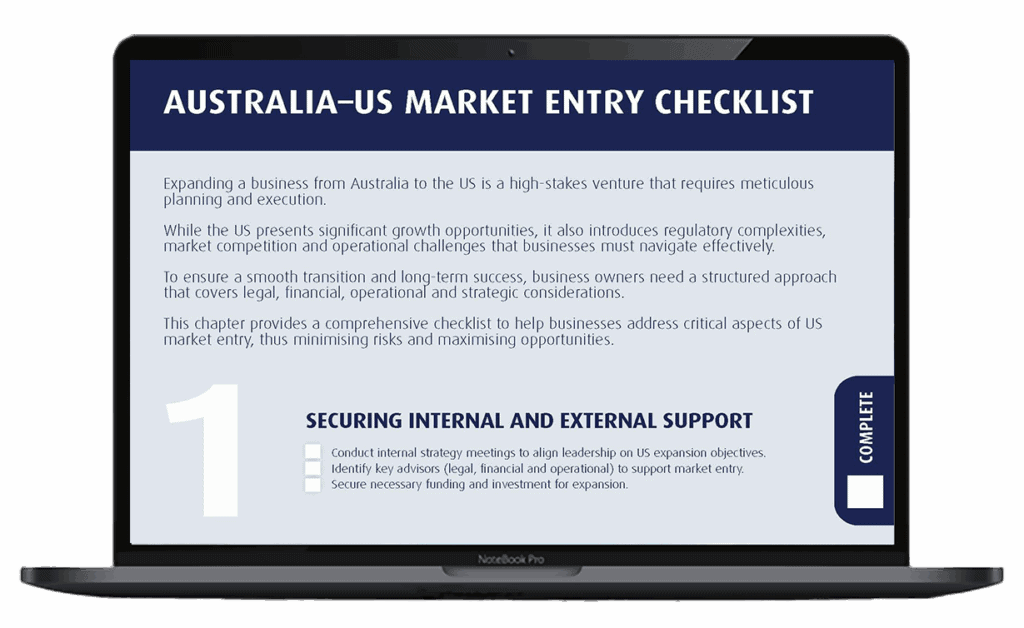
CHECKLIST: Australia – US Market Entry Checklist

To assist you and your team we have created the “Australia-US Market Entry Checklist“. The checklist guides your team through:

  • Identifying the most appropriate and strategic pathways for US expansion by Australian businesses.
  • Reducing expansion risk through clear tax, legal, and regulatory guidance.
  • Enabling a smooth transition into the US market and maximising long-term success.

NEED ASSISTANCE FOR YOUR SITUATION?

Contact us today
Contact Us

"*" indicates required fields

Do you need tax services in our other regions?
By providing us your information you agree to our privacy policy

Determining Corporate Residency

Use our online tool to determine the corporate residency of your client's business.

Corporate Residency

Please provide your details to access the online tool

Name is required.

Email is required.

Determining Corporate Residency

Use our online tool to determine the corporate residency of your client's business.

Place of
Incorporation

Is the company incorporated outside Australia?

Determining Corporate Residency

Use our online tool to determine the corporate residency of your client's business.

Central Management
and Control

Is the Central Management and Control
of the company exercised in Australia?

Determining Corporate Residency

Use our online tool to determine the corporate residency of your client's business.

Carry on a Business

Does the company carry on a business in Australia?

Determining Corporate Residency

Use our online tool to determine the corporate residency of your client's business.

Voting Power

Is the company's voting power controlled
by shareholders who are residents of Australia?

Determining Corporate Residency

Use our online tool to determine the corporate residency of your client's business.

The company is an Australian Resident

Contact us for tailored international tax advice
regarding your client's specific situation.

Contact us for tailored international tax advice regarding your client's specific situation.

Contact Us

Determining Corporate Residency

Use our online tool to determine the corporate residency of your client's business.

The company is not a resident
but it could be a CFC

Contact us for tailored international tax advice
regarding your client's specific situation.

Contact us for tailored international tax advice regarding your client's specific situation.

Contact Us

Determining Corporate Residency

Use our online tool to determine the corporate residency of your client's business.

Contact Us

"*" indicates required fields

By providing us your information you agree to our privacy policy

More articles like this


Australian Businesses Expanding To The USA: Grants, Incentives and Support Programs


23rd Jun 2026
John Marcarian

The US Incentives Playbook: How Australian Businesses Can Turn Expansion Into Advantage For many Australian companies, the United States looks deceptively simple, one country, one flag, one...


Australian Businesses Expanding To The USA: What Legal Considerations Must Understand Before Expanding


26th May 2026
John Marcarian

The US Market Is Not One Market: What Australian Businesses Must Understand Before Expanding For Australian businesses with global ambition, the United States often represents the defining...


Corporate Governance And Compliance Best Practices For SMEs In Singapore


22nd May 2026
Boon Tan

Many SME owners assume that corporate governance is something reserved for listed companies, large boards and institutional investors In practice, good governance is just as important for SMEs —...


Australian Businesses Expanding To The USA: Grants, Incentives and Support Programs


23rd Jun 2026
John Marcarian

The US Incentives Playbook: How Australian Businesses Can Turn Expansion Into Advantage For many Australian companies, the United States looks...


Australian Businesses Expanding To The USA: What Legal Considerations Must Understand Before Expanding


26th May 2026
John Marcarian

The US Market Is Not One Market: What Australian Businesses Must Understand Before Expanding For Australian businesses with global ambition, the...


Corporate Governance And Compliance Best Practices For SMEs In Singapore


22nd May 2026
Boon Tan

Many SME owners assume that corporate governance is something reserved for listed companies, large boards and institutional investors In practice,...

How To Prepare For Your First Tax Season After Moving Abroad

Marcus Shimotsu   |   6 Feb 2026   |   4 min read

A Practical Checklist For Australians Moving To The United States

Moving from Australia to the United States is exciting, but the first U.S. tax season can feel like stepping into a maze. The U.S. tax system is far more document-driven and globally focused than Australia’s, and many new arrivals are caught off guard by what the IRS expects.

The good news? With the right preparation before you move, your first tax season can be far less stressful. Here’s a checklist of items every Australian should gather and understand before relocating to the U.S.

1. Clear Records Of Your Move Date (This Matters More Than You Think)

Your exact date of arrival in the U.S. is critical. U.S. tax residency is not based on intention—it’s based on days physically present. You also need to have records of any dates you’ve left (even for temporary travel) the U.S. once you’ve moved.

Have on hand:

  • Flight itineraries and entry stamps
  • Visa start date
  • Lease agreements or housing contracts
  • Any travel dates after your move to the U.S.

These dates determine whether you’re treated as:

  • A nonresident,
  • A dual-status taxpayer, or
  • A U.S. tax resident for that year

This classification drives everything that follows.

2. Copies Of Your Most Recent Australian Tax Returns

Bring at least the last two years of:

  • Australian individual tax returns
  • Notices of assessment
  • PAYG summaries or income statements

These help:

  • Establish income earned before U.S. residency
  • Support treaty positions
  • Substantiate foreign tax credits later

Even income that won’t be taxed again in the U.S. often needs to be reported.

3. A Full Snapshot Of Your Worldwide Income (Not Just Salary)

The U.S. taxes based on citizenship and residency, not source. Once you’re a U.S. tax resident, the IRS wants to see everything.

Prepare documentation for:

  • Australian employment income
  • Bonuses paid after you leave (even if earned before)
  • Rental income
  • Dividends and interest
  • Trust or partnership distributions

If it earned money anywhere in the world, assume the U.S. cares.

4. Details Of All Australian Bank Accounts

Many Australians are surprised to learn that foreign bank accounts are a major U.S. compliance issue, not a minor one.

You’ll want:

  • Bank names and addresses
  • Account numbers
  • Maximum balances during the year

Why this matters:

  • Accounts may trigger FBAR and FATCA reporting
  • Penalties for missing these forms can be severe even when no tax is owed

This includes everyday savings and transaction accounts. 

5. Information On Your Superannuation Accounts

Australian superannuation is one of the most misunderstood areas in U.S.–Australia tax planning.

Before moving, gather:

  • Super fund statements
  • Employer vs personal contribution history
  • Withdrawal restrictions

The U.S. does not treat super the same way Australia does. In some cases:

  • Earnings may be taxable annually
  • Reporting obligations may apply even if funds are locked until retirement

This is an area where advance planning pays off.

6. Investment And Asset Purchase Records

If you own assets, documentation is essential to avoid double taxation later.

Bring records for:

  • Australian shares or ETFs
  • Property purchase contracts
  • Cost base and acquisition dates
  • Crypto transaction history

The U.S. uses different rules for:

  • Capital gains
  • Depreciation
  • Currency conversion

Without records, you may pay more tax than necessary.

7. Visa And Immigration Documents

Your visa type can affect how the IRS views you.

Have copies of:

  • Visa approval notices
  • I-94 arrival records
  • Employment authorization documents

Certain visas may qualify for:

  • Treaty benefits
  • Temporary exemptions from residency tests

But these benefits are time-limited and documentation-dependent.

8. Awareness Of The U.S.–Australia Tax Treaty

The tax treaty can:

  • Prevent double taxation
  • Modify how certain income is taxed
  • Provide tie-breaker rules for residency

But treaties are not automatic. You must claim them correctly on your return.

Knowing this ahead of time helps avoid missed opportunities.

9. A Cross-Border Tax Advisor (Before You Need One)

Perhaps the most important item on this list isn’t a document—it’s expert guidance.

The U.S. tax system:

  • Penalizes late or incorrect filings harshly (penalties for a single missing form can amount to tens of thousands of dollars)
  • Requires proactive reporting
  • Treats foreign assets with heightened scrutiny

Working with someone who understands both Australian and U.S. tax systems can save you time, money, and stress in your first year.

Final Thought

Your first U.S. tax season doesn’t start in April—it starts before you board the plane. A little preparation now can prevent expensive mistakes later and help you start your new chapter in the U.S. with confidence.

NEED ASSISTANCE FOR YOUR SITUATION?

Contact us today
Contact Us

"*" indicates required fields

Do you need tax services in our other regions?
By providing us your information you agree to our privacy policy

Determining Corporate Residency

Use our online tool to determine the corporate residency of your client's business.

Corporate Residency

Please provide your details to access the online tool

Name is required.

Email is required.

Determining Corporate Residency

Use our online tool to determine the corporate residency of your client's business.

Place of
Incorporation

Is the company incorporated outside Australia?

Determining Corporate Residency

Use our online tool to determine the corporate residency of your client's business.

Central Management
and Control

Is the Central Management and Control
of the company exercised in Australia?

Determining Corporate Residency

Use our online tool to determine the corporate residency of your client's business.

Carry on a Business

Does the company carry on a business in Australia?

Determining Corporate Residency

Use our online tool to determine the corporate residency of your client's business.

Voting Power

Is the company's voting power controlled
by shareholders who are residents of Australia?

Determining Corporate Residency

Use our online tool to determine the corporate residency of your client's business.

The company is an Australian Resident

Contact us for tailored international tax advice
regarding your client's specific situation.

Contact us for tailored international tax advice regarding your client's specific situation.

Contact Us

Determining Corporate Residency

Use our online tool to determine the corporate residency of your client's business.

The company is not a resident
but it could be a CFC

Contact us for tailored international tax advice
regarding your client's specific situation.

Contact us for tailored international tax advice regarding your client's specific situation.

Contact Us

Determining Corporate Residency

Use our online tool to determine the corporate residency of your client's business.

Contact Us

"*" indicates required fields

By providing us your information you agree to our privacy policy

More articles like this


Australian Businesses Expanding To The USA: Grants, Incentives and Support Programs


23rd Jun 2026
John Marcarian

The US Incentives Playbook: How Australian Businesses Can Turn Expansion Into Advantage For many Australian companies, the United States looks deceptively simple, one country, one flag, one...


Australian Businesses Expanding To The USA: What Legal Considerations Must Understand Before Expanding


26th May 2026
John Marcarian

The US Market Is Not One Market: What Australian Businesses Must Understand Before Expanding For Australian businesses with global ambition, the United States often represents the defining...


Expanding Into The US? Australian Businesses Need More Than A Good Strategy — They Need A Clean Reporting Foundation


15th Apr 2026
John Marcarian

When Australian business owners talk to me about entering the US, the conversation usually starts where it should - growth  A bigger market, deeper capital, more customers, stronger...


Australian Businesses Expanding To The USA: Grants, Incentives and Support Programs


23rd Jun 2026
John Marcarian

The US Incentives Playbook: How Australian Businesses Can Turn Expansion Into Advantage For many Australian companies, the United States looks...


Australian Businesses Expanding To The USA: What Legal Considerations Must Understand Before Expanding


26th May 2026
John Marcarian

The US Market Is Not One Market: What Australian Businesses Must Understand Before Expanding For Australian businesses with global ambition, the...


Expanding Into The US? Australian Businesses Need More Than A Good Strategy — They Need A Clean Reporting Foundation


15th Apr 2026
John Marcarian

When Australian business owners talk to me about entering the US, the conversation usually starts where it should - growth  A bigger market,...