
Expanding into the US can be a growth-defining move for an Australian business — new customers, deeper capital markets, a bigger talent pool. But there’s one reality that catches founders off guard: in the US, immigration isn’t a “formality.” It’s a regulated operating system. If you treat it like admin, it will eventually treat you like a compliance event.
At a high level, three agencies shape most employment- and investment-based pathways:
- USCIS (US Citizenship and Immigration Services) – adjudicates petitions and many work-authorisation processes inside the US
- DOL (Department of Labor) – protects US wage and working-condition standards (especially for employer-sponsored roles)
- DOS (Department of State) – issues visas at US embassies/consulates outside the US
When these agencies don’t align — or when documentation isn’t airtight — the cost is rarely “just delay.” It can disrupt onboarding, derail projects, and create legal exposure you don’t want attached to your US launch.
The E-3 Visa: Australia’s Unfair Advantage (When You Can Use It)
For many Australian companies and professionals, the E-3 is the cleanest entry point. It’s available only to Australian citizens working in a specialty occupation (typically requiring at least a bachelor’s degree or equivalent).
Why it’s so attractive:
- A dedicated annual cap (10,500) that has historically not been reached
- Lower friction and cost compared to many alternatives
- Renewable in two-year increments with the ability to extend repeatedly (so long as eligibility remains)
A major practical benefit: spouses of E-3 holders can obtain work authorisation (EAD) and work broadly in the US. For many families, that single feature makes the E-3 dramatically more livable than other work visas.
The key constraint: E-3 is not “dual intent.” In plain English: it’s designed as a temporary visa. You generally need to maintain the narrative (and supporting facts) that you intend to return to Australia. That doesn’t make a future green card impossible, but it does mean you need a plan — and you need to time it properly.
When E-3 Doesn’t Fit: The Other Work Visa Lanes
If the role or candidate doesn’t qualify for E-3 — or if permanent residency is part of the strategy — the next options depend on your structure and the person’s profile.
H-1B: The Well-Known Option (And The Lottery Problem)
H-1B also targets specialty occupations, but it’s open to all nationalities — which is why it’s heavily oversubscribed. Most applicants face a lottery due to annual caps (commonly referenced as 65,000 plus an additional 20,000 for certain US master’s degree holders).
Why companies still use it:
- Dual Intent (clearer alignment with future green card planning)
The downside many families feel most:
- Spousal work rights can be more limited and situational than E-3 (some H-4 spouses can qualify for an EAD under specific conditions, but it’s not as straightforward as E-3/E-2 in practice).
L-1: Ideal For Intracompany Transfers (If You Have The Structure)
L-1 is often the most logical pathway when you have a real operating company in Australia and you’re transferring someone to a US entity.
- L-1A for executives/managers
- L-1B for specialised knowledge staff
- Requires the employee to have worked for the overseas entity for at least one year within the preceding three years (in most cases)
- Dual intent is permitted
This visa often works best when your corporate structure and role definitions are clean — and when your organisational chart supports what you’re claiming.
O-1: For Top-Tier Profiles With Evidence To Match
The O-1 is for individuals with extraordinary ability (business, science, arts, etc.). There’s no annual cap, and extensions can continue as long as the work remains eligible.
But this is not a “strong resume” visa — it’s an evidence visa. Think:
- major awards or significant recognition
- published material about the person
- critical roles in distinguished organisations
- judging, original contributions, high salary, and other recognised criteria
If the story is “they’re excellent,” O-1 is hard. If the story is “their excellence is documented by third parties,” O-1 becomes very viable.
The E-2 Visa: The Founder/Operator Pathway
For entrepreneurs and owner-operators, E-2 can be a powerful route. Australia is a treaty country for E-2, and the visa is designed for people who will develop and direct a US business they’ve invested in.
Key points that matter in real life:
- You generally need to own at least 50% (or otherwise control the enterprise)
- The investment must be substantial and genuinely at risk (committed and exposed to loss)
- There’s no fixed minimum, but in practice investments often sit in a broad range (commonly US$100k–$500k+, depending on the business model)
- The business can’t be “marginal” — it should be capable of supporting more than just the investor’s household over time
Like the E-3, a major family advantage is that E-2 spouses can obtain open work authorisation.
Compliance That Actually Matters: LCAs, Files, And Timelines
For E-3 and H-1B, one recurring compliance anchor is the Labor Condition Application (LCA). This is where the employer certifies (to the DOL) that the worker will be paid appropriately (prevailing wage rules) and that hiring them won’t undercut local working conditions.
A few operational truths:
- Processing timelines vary – E-3 can often be relatively quick; H-1B and some USCIS petitions can take longer due to caps, scrutiny, and workflow
- Your file is your defence– job descriptions, wage rationale, organisational charts, degree equivalency support, and consistent HR records matter more than people expect
- Tracking expiry dates isn’t optional – late renewals create avoidable risk and business interruption
The Tax Trap: Immigration Status ≠ Tax Status
This is the part that blindsides many Australians.
Your visa category does not determine US tax residency. The IRS applies the Substantial Presence Test, which is based on days in the US over a rolling period. It’s entirely possible to be on a temporary visa and still become a US tax resident, meaning worldwide income may enter the US tax net.
That can pull in items Australians don’t expect to be “in play,” including:
- investment income from Australia
- complex treatment questions around superannuation
- reporting regimes that can apply to foreign accounts and entities
- state tax exposure (often the nastiest surprise), especially in places like California and New York, which operate with their own rules and don’t “care” as much about treaty outcomes as people assume
The US–Australia tax treaty can help mitigate double taxation, but treaties don’t automatically make complexity disappear — they often just change how you need to document and position the outcome.
The Mistakes That Create Expensive Problems
A few patterns show up again and again in US market entries:
- Misclassifying Employees As Contractors To “Simplify Payroll”
This can trigger issues with the DOL and IRS, and it’s a fast way to attract scrutiny. - Building The US Plan First And Asking Immigration To “Make It Work” Later
Better approach: design the role, entity structure, and timeline with the visa pathway in mind. - Overstays And Timing Errors
Overstaying by more than 180 days can trigger a three-year re-entry bar, and one year can trigger a ten-year bar. Those are business-ending outcomes for the wrong person at the wrong time.
A Practical Way To Think About It
If you’re entering the US, treat immigration and tax as two parallel workstreams:
- Immigration Workstream – right visa, right evidence, right timing
- Tax Workstream – residency modelling, entity/payroll setup, cross-border reporting, state exposure
When those two streams are coordinated early, the US expansion feels controllable. When they’re not, businesses find themselves reacting — and reaction is always more expensive than design.
General information only — not legal or tax advice. US immigration and tax outcomes depend heavily on facts, timing, and documentation.
CHECKLIST: Australia – US Market Entry Checklist
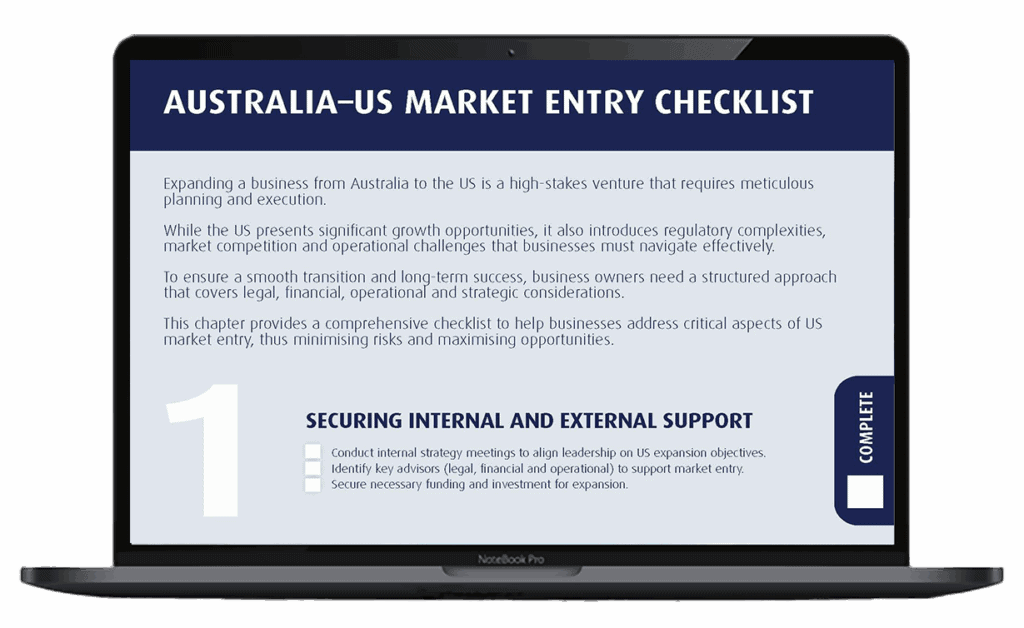
To assist you and your team we have created the “Australia-US Market Entry Checklist“. The checklist guides your team through:
- Identifying the most appropriate and strategic pathways for US expansion by Australian businesses.
- Reducing expansion risk through clear tax, legal, and regulatory guidance.
- Enabling a smooth transition into the US market and maximising long-term success.